092: Slow and Small Steps to Healing Your Shattered Soul with Colleen Ramser
Jul 21, 2026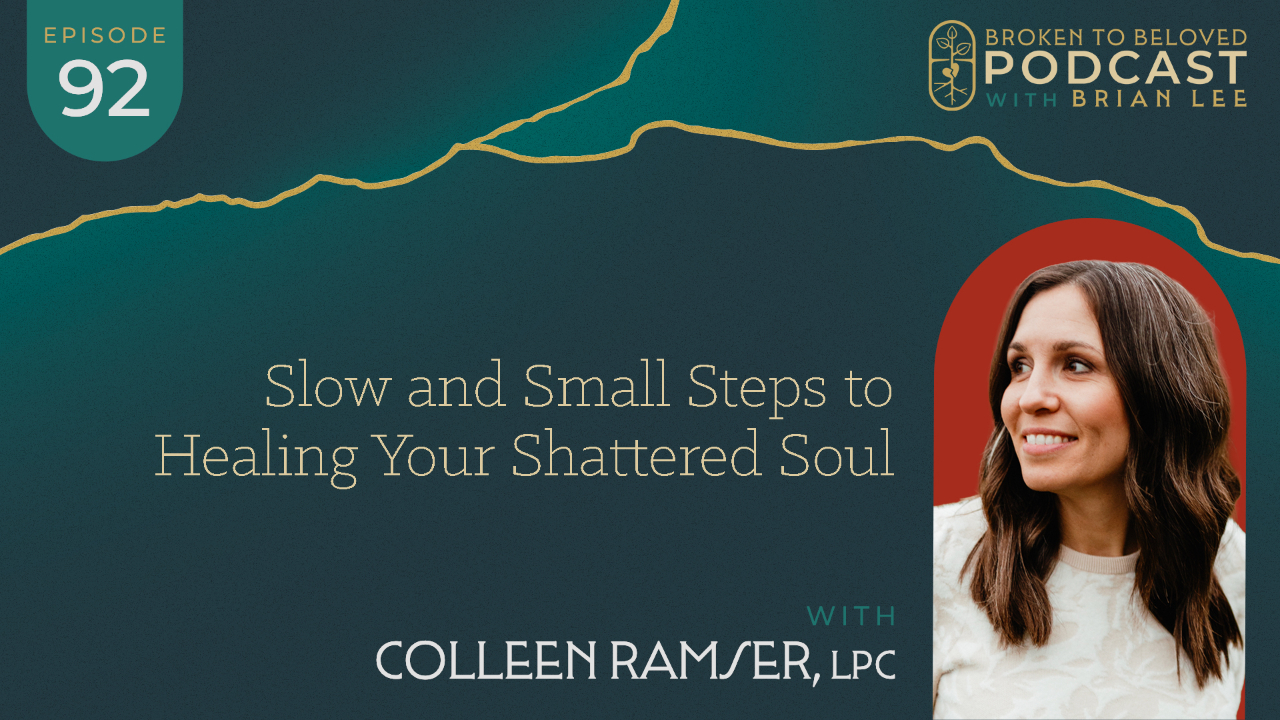
What if forcing spiritual practices make healing harder — not easier?
Therapist and author Colleen Ramser joins the podcast to discuss her debut book, The Shattered Soul: Restoring Wholeness and Rebuilding Your Faith After Spiritual Trauma. Drawing on 15+ yearsof clinical experience, Colleen offers a compassionate, body-aware path forward for survivors who feel like their faith has been shattered beyond repair — and makes the case for going slow, starting small, and giving yourself permission to set down practices that are doing more harm than good.
You’ll also hear about
- Exploring neutral sensations as an alternate option to overwhelming positive or negative sensations
- Exploring the “somatic soul” and why addressing the body is often the first step toward reconnecting with your faith.
- Discerning the difference between persuasion, influence, and coercion
Guest Spotlight ✨
Colleen Ramser, M.A., is a licensed therapist, speaker, author, and podcaster specializing in trauma—particularly spiritual abuse, domestic abuse, and complex trauma. An EMDR Certified Therapist™ trained in somatic and internal family systems therapies, she brings over 15 years of experience in ministry and clinical practice. Colleen frequently trains and consults with faith leaders and mental health clinicians on survivor care and addressing systemic harm.
She is the author of The Shattered Soul: Restoring Wholeness and Rebuilding Your Faith After Spiritual Trauma. As a survivor of trauma, Colleen is a compassionate witness on the journey, bringing not only her clinical expertise but also a deep knowing of dark nights and the breath of new mercies. Colleen lives in Louisville, KY, with her husband and two kids.
Links & Resources 🔗
Website | Instagram | Facebook
- Here Not There Podcast
- The Shattered Soul by Colleen Ramser | Amazon | Bookshop
- Anchored by Deb Dana | Amazon | Bookshop
- Didn’t See It Coming by Carey Nieuwhof | Amazon | Bookshop
- Hope for Cynics by Jamil Zaki | Amazon | Bookshop
- Apply for The Shattered Soul Book Cohort
Don’t Miss the Next Episode!
Sign up for our Podcast Newsletter and subscribe on your favorite podcast app below and never miss out on these conversations with old and new friends. Is there a guest you’d like to hear from? Let us know!
Apple Podcasts | Spotify | Amazon Music | YouTube
Spread the Word. Leave a Rating and Review. It would mean the world if you would leave us a rating and review on Apple or on Spotify or share with your friends.
Broken to Beloved is a 501(c)3 nonprofit that works to provide practical resources for recovery from and safeguarding against spiritual abuse. Our programs like this podcast are made possible in part by the generous donations of our supporters. Consider joining our community of supporters with a gift of $25 today.
As an Amazon and Bookshop.org affiliate, I may make a small commission at no extra cost to you.
Episode Transcript 📄
Colleen Ramser
I would say the majority of people in this context, you know, they were literally retraumatizing themselves. It was— there was no experience of God. There was no experience of Jesus. It was nowhere to be found in their forced practices. And so to me, it was like, gosh, what— can we slow down and find even just the smallest thing? I mean, I remember periods of time where all I could do, literally, I mean, this was, this was my journey. And, you know, I could have beat myself up about it and told myself that I'm not a good enough Christian. But the point is, if the point of practices are to be formed and for our spirituality to be engaged, then we have to pick things that are going to actually do that and not retraumatize us.
Brian Lee
Hey friends, welcome back to the Broken to Beloved Podcast. If you're looking for practical resources for recovery from and safeguarding against spiritual abuse, then this is the place for you. I'm your host, Brian Lee. I'm an ordained pastor and spiritual abuse survivor, and I know what it feels like navigating life after spiritual abuse. It's why Broken to Beloved exists, and we can't do it alone. We need your help. Support our work by becoming a donor to help make our podcast and programs possible. Just head to brokenbeloved.org/support or click the link to donate in the show notes. Just $10 a month would go a long way to making our work more sustainable.
Today I'm thrilled to be talking with therapist Colleen Ramser about her new book, The Shattered Soul. Colleen is a licensed therapist, speaker, author, and podcaster specializing in trauma, particularly spiritual abuse domestic abuse, and complex trauma. She's an EMDR-certified therapist trained in somatic and internal family systems therapies. She brings over 15 years of experience in ministry and clinical practice. She's been on our Summit, I think, at least 2 years, maybe 3. You'll hear about that at the top of the episode.
And I'm really excited to share this conversation with you. And so without further ado, here's my conversation with our friend Colleen. Colleen, welcome to the podcast.
Colleen Ramser
Thank you. It's so fun to be with you.
Brian Lee
It's exciting. We were just saying, we've— I think we've done at least 2 summits, maybe 3, but first time on the podcast. So love that we get to share you with the rest of our bigger audience here. Congratulations on the release of the book.
Colleen Ramser
Yay! I'm so excited. It's— I've told people it's like exciting yet terrifying. Yeah.
Brian Lee
And I imagine it's like a marathon, right? Feeling like the, and not even the end of it yet. Cause now this is kind of the beginning of a new life for it.
Colleen Ramser
Yeah. And I, you know, it's funny, I was thinking about it the other day and it's just been so busy that like I finally started to connect to the reality, like in my body and was just kind of tearing up a little. I was like, oh my gosh, like the baby's coming. Like, mm-hmm. You know? So it's been interesting, even the process of releasing it. Like I think I've just been go, go, go, go, podcast here, podcast there. But just, really pausing and connecting to it, like, this is real. It's real.
Brian Lee
It is very real. And I've been honored to be part of the process since I don't even know how long ago it was now. Yeah, I got the draft of it. So honored to endorse it with you and partner with you here. If you could think of like 3 things about the book that you are either excited about, hopeful for, and maybe afraid or anxious about.
Colleen Ramser
Yeah.
Brian Lee
As it releases into the wild, what do you think?
Colleen Ramser
I'm excited about the potential that it may help others heal, or at least begin the journey. You know, it's definitely not a book that's meant to like heal all things, but I do see it as a book that if someone is just lost, they don't know where to begin, that this is a very practical tool and has a lot of common themes that people struggle with in this context, that it will give them something to digest and chew on for sure, and some traction, I hope. And so that kind of leads into the hope. So far, I was just telling you before we pressed, you know, pressed record that, you know, the launch team and being on different podcasts, people, you know, kind of engaging the book so far, I've been excited and hopeful because what I had hoped would happen with the book is happening and people are really appreciating the content. And it's, and it's even, even like someone the other day in the launch team said, it just feels like you're sitting with me throughout the book. It feels like you are strategically creating a safe space, like chapter by chapter. And I was like, yes, that's exactly what I wanted to happen.
And so, you know, it's like, it's nice to feel like all of those, that sweat and tears that you put in and the many hours is like, It's like doing what you had hoped it would, at least right now. Like I said before we started recording, like I'm sure there are gonna be bad reviews. It's not gonna be everybody's cup of tea, but at least the people that are engaging in the content, like it's doing what I had hoped. And what am I afraid of? Hmm. I, you know, I think I imagined, if I'm honest, like that worst case scenario of like being on some major platform and somebody is like totally dissecting the book, but they're not my audience. You know, and they're like, it's this bad, this bad, that bad, this, you know, because I mean, it doesn't matter. There are Christians out there that can really critique a book. And so sometimes that feels a little unsettling, but I'm okay with it. I came to peace with it when I wrote the book that that was going to be the case. So that's a little terrifying in some ways, but also I'm like, eh, you know, you're just not my people.
Right.
Brian Lee
And you're not, and you're not the audience, right?
Colleen Ramser
Right, right.
Brian Lee
I mean, I think it's so solid. I found the book to be so invitational, which is something I'm always looking for when I'm thinking about resources to share with our community. I know so much of it was very intentional. I think you even say in the introduction or the foreword, it's like that this is all offered as an invitation and it's never a should or a demand. I love the invitation to just go slow and start small, which you repeat throughout the book. Tell us about that process in writing it, how like how to make that invitational and slow and small, because there's so much in here.
Colleen Ramser
Yeah. You know, it's interesting too, even on the launch team, there's someone on the launch team who reached out to me and was just like, you know, this is— it's good content, but it's hard to go through so quickly, you know, because it's 4 weeks of a launch team. And I just said, you know, I would much rather you slow down. Like, it's more important to me that you slow down and engage this content at a pace that your mind and your body and your soul can tolerate than it is for me to, you know, have you do some social media post or a review. Like, I really want people to feel like they can press pause and close the book at any time because it's too much, you know? And so the process of doing that, you know, writing is such an interesting craft. And I think some people are so good at it. And then, you know, other people are really good at speaking. I'm more of a speaker. So, you know, my editor and I, we, we had to kind of go back and forth a lot with here's what I would say in a, in a context of a client in my office.
And then now I have to kind of like somehow make that in a way that people can read it, you know, that it makes sense to them. So it was, it was challenging to kind of go back and forth in that way. But I really tried to imagine a handful of clients in my mind that really you know, meant a lot to me, and I really wanted them to feel safe with me. And I just imagined myself like writing them letters in a lot of ways, you know, or what they might need in the moment, what sort of a follow-up phrase or statement that might come to their mind when they read this. And so it was, it was challenging, but, you know, going from therapist office to page on a paper, You know, I, I seems like I accomplished it a little bit.
Brian Lee
I think you accomplished a lot of it. So congratulations again. I realize we've been talking for a couple of minutes and people may have no idea what we're talking about, but here it is. Your first book, correct?
Colleen Ramser
Yes, very first one.
Brian Lee
The Shattered Soul: Restoring Wholeness and Rebuilding Your Faith After Spiritual Trauma. I loved it. It's such a good and practical and like we said, invitational resource.
Colleen Ramser
Yeah.
Brian Lee
I think right at the top you say that, "While not everything that causes hurt in a religious setting constitutes spiritual abuse, many things can result in spiritual trauma." And I thought that was such a helpful distinction. Help us understand the difference between spiritual abuse and spiritual trauma and why knowing that difference is important.
Colleen Ramser
Yeah, so it's interesting too, I've been saying this on podcast 'cause my editor really pushed me to get very specific about this because I so often deal with the aftermath that it's, you know, it's coming from a place of— for me, it's like, I, it, you know, yes, identifying it with my client, was this abusive? But I was so much more wanting to engage them in the aftermath and, and what do we do now? That she's like, but you've, you've really got to hone in on what do you— how do you define spiritual abuse?
And so for me, coming from more of like a somatic background, more like embodiment, like, I really thought about it from more of like a posture, or like how people are showing up. And so people use lots of different things to get what they want. And in a spiritual religious context, to me, spiritual abuse is when a person or system of persons in perceived or real power— and, and I say, I say that because sometimes it might not be a pastor, sometimes it might be even someone who is a friend that is a spiritual mentor but has some level of power spiritually in your life.
You, you know, they have some sort of kind of authority or power context in a religious context, because I would hear people who would feel really harmed by not just a pastor but a community leader or somebody who was involved in some sort of ministry context within the church, but they didn't really necessarily have that identified title.
And so then I began to think about the James verse, that they use any means necessary to secure outcomes, where someone wants what they want and they're willing to kill and scheme to get it. It doesn't— you know, they, they can use all kinds of things, you know, whether it's manipulation, exploitation, removing spiritual mentorship, or neglecting someone spiritually, forcing them into, you know, sex if they're a spouse, using scripture. There's all these different things that people can use when they have this religious authority and secure outcomes at the expense of someone else's spiritual well-being.
And so what happens then is the way trauma works, and as you know, it begins to kind of have this overlay, it merges. And so even in my opinion, someone doesn't necessarily have to use scripture to— for it to be considered spiritual trauma.
It could be just that person was in spiritual— some sort of spiritual authority, and because there's a religious context to some degree, that, that can merge with trauma and your faith. And so it might not be that they directly use scripture, directly used a worship song, but because of the context, what happens with trauma is your faith becomes a trigger, worship becomes a trigger, you know, reading Scripture, all of those things become a trigger because they're associated with the person who's in power, this religious context.
And so it might be specifically Scripture, it might be specifically, you know, a worship song that you hear because that was used against you in some way, but it could also just be a whole host of things that have hindered you from Connecting to God, connecting to others who call themselves Christian, connecting to faith practices, being in community, some sort of religious or spiritual community to some context.
And as we know about trauma, there's intrusive thoughts, there's an avoidance of some of these practices. There's a lot of times hypervigilance or hyperarousal where someone becomes anxious about their faith, about practices, about God, about things that remind them of that spiritual context, or they feel incredibly shut down, maybe spiritually depressed.
They can't feel anything in their faith. They feel numb. They, you know, so there's, there's a host of symptoms that come along with that, but that's kind of the general idea of how I view spiritual abuse and then how that kind of goes into spiritual trauma, which is like a lasting impact. It is now impacting someone's physiology, their mind, their body, their soul. It's impacting their faith.
Brian Lee
That's really helpful. Thank you. And I appreciate that you also include a list of what is not spiritual abuse, but may still be hurtful or disappointing, right? Because I think there are a lot of people, especially when you say real or perceived, right, that sometimes these perceived things can be perceived as abusive, but we're just so misattuned or we're so primed or we're so, you know, all of these things that everything gets interpreted as abuse, like, no, no, no, they let you down. They disappointed you. You feel betrayed. Maybe not necessarily abusive.
Colleen Ramser
Right? Yes. I felt like it was important to, to go there because a lot of times I walk the line of working with churches and pastors and ministry leaders, but I also sit with victims and survivors and people who have experienced spiritual abuse and spiritual trauma. And so that's another kind of like why it was so challenging at times because in my mind I was thinking, well, it doesn't seem like that person was maliciously trying, you know, to secure an outcome. It just so happened that there was a conflict, a disagreement, or even a letting go from staff, you know, because they weren't doing their job or whatever it was. But that can result in spiritual trauma, you know, which is different.
You know, someone can have an experience that's not spiritually abusive, but it, it leads to symptoms of trauma. And so I really wanted to kind of give some clarity there because, you know, just like anything, it's like, and it's not to minimize any harm that's done. I think for me, it was, you know, so often we can throw out that person's narcissistic. Well, that's abusive. Well, this is, you know, and I wanted to be like, well, wait, let's just take a second because I don't think that everything is spiritually abusive or has that quality that someone is trying to secure an outcome.
I also think that there are people, you know, like I said in the book, it's a slippery slope because I do think that there are people who— what would I say? Uh, this is the only word I can come up with, just ignorant. They just don't understand that what they're doing is not okay. And until someone says this isn't okay, you know, a lot of times I'll see that in systems where everybody else is following the system and they don't realize that actually this is theologically incorrect or not the way to go about things, doesn't look like Jesus.
And so, you know, when you don't know, you don't know, but when you do know, you're responsible, uh, you know, for changing that. But I like to say in the book, it does not negate the hurt. It doesn't negate the fact that you may, it may have resulted in spiritual trauma. And so it doesn't, it doesn't minimize it in any way. It just might look different in terms of how that other person is processing what has happened.
Brian Lee
Yeah, that's good. I love the way that you talk about integrating minds, bodies, spirits, souls, right? How one part of a wound a wound to one part impacts all of us.
Colleen Ramser
Yes.
Brian Lee
I feel like I'm learning so much about that embodiment and that integration and how shattered soul— it's like when we split ourselves off into all these pieces, we're going to do damage. And you write about something you call the somatic soul, which I don't think I've seen anywhere else, which I love. Tell us about what is the somatic soul?
Colleen Ramser
Yeah. So as I was, you know, thinking about this book and as I've worked with others, Trauma has a way of perceptually, even though we know we're interwoven, it has a way of perceptually in our mind, it feeling like we're separate from ourselves, or we're fragmented, or there are parts of us that don't feel near, or, you know, parts of our story that might not even feel close. It just feels like it's all shattered.
What I saw with spiritual trauma was this sort of detachment from your spiritual self. Like there was this kind of, that part of me is far away and I don't know how to like integrate that part back in. And so this term, the somatic soul, kind of came from, you know, I, I'm, you know, I've had some training in somatic experiencing, you know, in physiology and things like that. And so I began to think about the combination of those two and that it's not just 'Let's just think how I can change my thinking and my mind about my, my situation, but how can I engage my whole self, my whole physiology in relation to my soul?' And, and so that was kind of where it came from.
You know, I do think that even as I put that in the book, I still think that there are a lot of churches and Christians who are still so hesitant to talk about the body. It's like this If we go to the body, then we're, we're just, it's just too much. We're gonna, we're gonna like fall into a deep trap of, you know, flesh. And, but so clearly what I was seeing with people's healing journey, recovering from spiritual trauma, and even in my own process, was that I often have to address the body to get to the soul, if that makes sense.
Like, it was like, we can't go to scripture and these heavy places about worship and theology and the Bible and, you know, go to church, and you've got— this is how you're going to recover your faith. Like, when I sat in the room with someone and read a psalm over them and they had a flashback for 2 hours, then, you know, it was like, this isn't work. That doesn't work. And so I often had to start with the body, help them kind of clear out some of that stuff and that thing, you know, what's merging with their faith and causing it to be painful, so that they could engage parts of their soul, if that makes sense.
Brian Lee
Mm-hmm. I think that's super helpful. I appreciate the way you talk about safety and having anchors, right? Because so often when we've experienced or carry trauma, you mentioned earlier, like the hypoarousal, the hyperarousal, all these, you know, activating triggers, right? These things. And you mentioned that after spiritual trauma, faith practices that once provided anchors for our soul may now be anxiety-provoking. That's huge. Because I don't think people really— they think, oh, I should just do faith as usual, or church as usual, or all these things, when those are the things that are going to constantly push us into activation, right? So help us out with reexamining, being okay with changing, leaving behind, possibly returning to these practices and finding or discovering new or different anchors in that season.
Colleen Ramser
Yeah. KS: I've often thought of it this way, that a lot of times we have to push these things away to reintegrate them back in, and sometimes they have to be kind of off the table for a while. You know, that maybe instead of trying to force yourself, "Well, I've always just read scripture every single day." It's not that I'm trying to be like, "Oh, don't read the Bible, you know, uh-oh." You know, but I've met a lot of people who just can't do it and it just keeps retraumatizing them.
And so instead, they're doing things like that might feel really little and small, but they're just pausing and being with their body as they think about God. You know, like not this grand devotional where they've got the list of spiritual disciplines and they're checking all of the boxes. But you often have to be really creative with what feels spiritual and what feels like an anchor. And so, I offer a lot of just kind of basic things, you know, to start that may not even be necessarily a quote faith practice, but it's helping you, you know, anchor in your body, feel a sense of safety to some extent in your environment to then later in the book to look at some harder things.
You have to have have that safety, or at least a little bit of it inside your body, or a felt sense of it externally, in order to look at some of these things that feel really unsafe. And so I wanted to try and give— I do give some things in there that are more, probably more spiritual, but with a little twist. I think, I think the anchoring chapter, is that where I, I do the Spiritual Beatitudes? I'm trying to remember myself.
Brian Lee
I can't remember either.
Colleen Ramser
I'm trying to remember, but, but I kind of encourage people to sort sort of change up the Beatitudes to kind of reflect their body, you know, like, like something to the effect of like, held are my arms because, you know, they helped me get through whatever it was. Or even change up the wording. Instead of saying blessed, because that can be very triggering for someone, I just say use something else, you know, like instead of saying blessed, you know, say held or cared for is my belly that's nervous because it's trying to protect me. And so I, I, I think there's a, you know, there's a, you know, the, the, the list is endless in terms of like how people can be creative with what helps them feel safe or a sense of calmness in their body. And for some people, they might be able to kind of integrate a piece of scripture. Other people, they're not gonna be able to. Um, but I give some internal anchors, you know, things that you can do inside. You can, you can do some external anchors, things like body anchoring to like a place where it helps you kind of bridge that gap and feel grounded and rooted.
And so yeah, I know I'm kind of going, you know, to different, different locations in the book probably that I'm forgetting that are not, not in the anchoring chapter.
Brian Lee
I'm gonna say you're just living the whole thing all at once anyway. It's— well, yeah, and you do the internal and external anchors. I I love Deb Dana's work and her book on just anchor this. And you offer a lot of really practical exercises for people to just take their time. Yeah, go slow, go small, and just do one or two of these things to see if it works for you as an anchor. And again, I think it's so helpful.
It's in that section that you also talk about neutral sensations, which I would love to talk about. I love the idea of it. I want to talk more about it because it's something I'm unfamiliar with and I think You know, we often hear about identifying positive or negative physical sensations, not necessarily as good or bad, but just as signs for us to pay attention. And you write that you value neutral sensations for their ability to provide an in-between space.
Colleen Ramser
Yes. Yes.
Brian Lee
Very often when I'm working with coaching clients or with like within our cohorts, we do story work, we do all kinds of other stuff that we're doing. And people are, you know, a question that comes up a lot is like, hey, what are you noticing? What are you noticing in your body? What, like, what? And people are like, I have no idea. And they just don't know what to say. Right?
Colleen Ramser
Right.
Brian Lee
They feel unable to identify what's happening. The trauma has caused them to feel utterly disconnected from their bodies because they've been told for so long that your body is bad. So just ignore it, dismiss it, push it down, push it away.
Colleen Ramser
Yes.
Brian Lee
Help us, like, would working on identifying neutral sensations help here? And like, what are, how do you describe a neutral sensation?
Colleen Ramser
Yeah, yeah. So I love neutral sensations because sometimes people have a hard time kind of going to the positive sensation because it will trigger the negative. And then, you know, going to the negative can feel really overwhelming and scary. So they'll avoid there too. So there's this kind of, well, where do I go? You know? And so both feel really triggering. So neutral sensations are those areas in your body that just feel kind of like meh. You know, like my big toe doesn't have a lot going on, you know, like it's just, it's just there doing its thing. Like it doesn't really, it has a little nail polish, but that's about it, you know? Like, so there's, there's not a whole lot going on in that part of my body and it can, it can provide like such a great resource and bridge to being in the present. And so if I can't go to the positive or the negative, at least I can go to my big toe. And we can, we can kind of ground there. And all you need literally is, is a very tiny little space in your body that feels neutral.
And neutral, like I said, is kind of like, I mean, I think that I go into the book about like what a neutral sensation could feel like. But it's, it's kind of like there's really not a, you know, negative sensation that you're attaching to it where you feel maybe anxiety or fear in that space, or maybe, you know, a sense of emptiness that feels hollow would be probably more of your negative sensation, but it's also not this warm, tingly, exciting, vibrating, you know, aliveness feeling in that space. There, it just feels kind of indifferent. There, there's not like a huge negative or positive there that you're, you're sensing in the extremes. And so if you can identify a space like that in your body, I feel like it's, like I said, such a bridge when you can't go to the physical or the negative.
Brian Lee
Yeah, I think that's really helpful. And I think like you're saying, just kind of describing those benign things like, this is my big toe, it's fine, it's there, but it's just something to choose to pay attention to when you don't know where else to put your attention.
Colleen Ramser
Right, right.
Brian Lee
And again, it feels invitational to just have that in-between space of like, I don't know that it feels good. I don't know that it feels bad. I just kind of feel bleh. And it's like, okay, let's start with a neutral sensation. I think is a really helpful, like, guiding point for people who don't know where else to go.
Colleen Ramser
Yeah.
Brian Lee
I haven't seen too many other people in this space address cynicism directly the way that you have, which is great. Is cynicism the same as being jaded? And I have a reason for asking that question that has to do with like like my early days of counseling and therapy is like, for the first several months, it felt like I was showing up to the sessions just like, I just feel jaded. And then my therapist kept saying, no, no, no, you're not jaded, you're this, you're that. It's like, there are reasons for this. It's like, are you sure? And then, oh, okay, maybe. And then recognizing there is a lot of cynicism out there that's happening.
Colleen Ramser
Yes.
Brian Lee
You know, what do you think?
Colleen Ramser
Let me ask this: how would you define jaded? I don't turn it back on you, but I think I want to hear kind of what you mean by jaded before I really assess the two.
Brian Lee
I feel like maybe it goes a step beyond cynicism because I think you do a great job defining cynicism and kind of the boundaries of it. I've appreciated Carey Nieuwhof's work on cynicism.
Colleen Ramser
Yeah.
Brian Lee
In his book. And I think where the cynicism is like looking to push and ask questions in search of the inevitable thing that's going to let me down, right? The things hiding behind the surface. I feel like jaded goes a step beyond that. It's like, no, no, no, no, no. It's just all bad. Like, I don't need to go looking. I just know from the outset. And it's just this, this outlook on life that has changed that doesn't allow for the curiosity, that doesn't allow for even the hope of— because I like Jamil Zaki's book Hope for Cynics was really helpful in, in kind of defining those things. So I think that's kind of where I'm coming from.
Colleen Ramser
Yeah. Yeah. I, I think when I was writing that chapter, I was imagining the per— like the person who's just a little like cynical about the church all the way to the point of probably jadedness. I— that was kind of the person that I was imagining on both ends of the spectrum of like just a little bit like church is a joke, I don't know how I feel about my faith, and then the person that's really pushing hard and saying, you know, there is no hope for this. Like there, there is almost like the black and white that you know, everybody is bad in the church, all leaders are gonna fail me.
And so I, I kind of imagined, I think, all, all of that, you know. I think probably in my mind, the maybe a step beyond jadedness is the person who has just decided, has made the decision that they are no longer going to pursue their faith, that they are like, I'm done, you know. So I would say someone who's cynical and maybe jaded, there's still enough there for me to engage them in curiosity, that they still have maybe some level of interest in recovering their faith or figuring, you know, finding a way to do so with some, with some right tools and right resources that they're willing.
And so maybe, yeah, I think that I'm, I'm definitely, when I imagined that chapter, I was thinking about I mean, even in my own journey with it, being cynical, you know, I think I was pretty jaded for a little while myself.
Brian Lee
Oh, for sure. Same. I think the way you write it, it occupies this spectrum of, you know, slight cynicism of like, "Yeah, I just don't think so," or "Let me ask a question because I'm expecting—" Because you say, "At its most intense, spiritual cynicism doesn't just doubt goodness in others, it doubts that goodness can exist at all." And I've definitely been there. Yes. And you open it— I just love this line. I don't have a question about it, I just have to— I highlighted it a few times because you're talking about being at a Bible study and all these women are sharing these phrases and these scriptures and what you call Bible bows. And I love the way that you say it. You said, hearing them left me feeling like someone was shoving a loaf of daily bread down my throat.
Colleen Ramser
I was so incredibly cynical, like for real, Brian. Like I I was just like, this is dumb. Like, it was like, it took me a lot. I mean, I, I don't even want to admit this on a recording, but like, it took me, it took me a really long time to even like go to a women's retreat and not feel that just like, okay, when are we going to talk about the Bible bows, you know? Or when are we gonna like pretend about what's really hap— like, I think it took me to an edge. And, and I actually said this on the launch team with someone that I think a lot of times we push when we're cynical, we push when we're jaded, and we push really, really hard and to the extreme and to the extent of this edge in order to find our way back to the middle again. Because I think that when you experience spiritual trauma, it just shatters this ideal that you thought about the church, you thought about Christians, you thought about anything in your faith And finding that middle space again sometimes I think requires us to explore those extremes.
I think to find our way back into actually, this is probably the more holistic space to be. That like, yeah, like there's people who find Bible bo's and there's people who don't, you know.
Brian Lee
But I appreciate the vulnerability of it and just even just naming that. It's like, I think for a lot of a lot of people who feel cynical but maybe are afraid or unable to express that or to name it will be like, yes, this is what it is. And it's okay because it is a trauma response. It's like, it makes sense why I feel this way.
Colleen Ramser
Yes, yes. And my hope with the chapter 2 was I don't want people to stay stuck there. I know it's, it's a space to be, and you're, you know, it makes sense to be there. And I wanted to gently invite them into what does it look like to move through that? What does it look like to kind of have some things to digest and chew on so you don't stay stuck there? You know, with the caveat that there's still things even in my own life right now that I still feel a little cynical about, and I have to kind of pause and work through and be curious and all the things I talk about, you know.
Brian Lee
Yeah. Okay, bear with me because this is a long passage. Yeah, but it was for me one of the most profound passages in the book. And I would just love to hear more about it: "The only alternative to showing up authentically is showing up inauthentically, which is what happens when we try to experience God's presence by forcing ourselves into spiritual practices that trigger the trauma in us. If the relationship we build or rebuild with God is based on little more than adherence to a spiritual formula it won't be long until it's the least intimate relationship we will ever experience. No amount of devotion to spiritual practices can cure that. And if being formed into the image of Christ is the goal, then forced practices that create anxiety or shutdown are not the answer. Instead of forming us into the image of Christ, they will increasingly form our neural networks into the image of our trauma."
Oh my goodness, Colleen, that was so powerful. Yeah. Tell us more.
Colleen Ramser
I, you know, I, even as you, I hear you like read that, I remember the passion I had while like writing that because I was so frustrated with, you know, ministry leaders or people who would try to force people to, to, you know, pray more or submit more or don't pay attention to your body. You know, or even, you know, well-meaning people who kind of thought like, well, if you just read and, you know, allow yourself to be open to the Holy Spirit, like then redemption is going to happen and you're going to heal and it's just going to happen.
And it's not to say that that doesn't happen for some people, but I would say the majority of people in this context, you know, they were even self-inflicted, forcing themselves to do things that were like literally retraumatizing themselves. It was— there was no experience of God. There was no experience of Jesus. It was nowhere to be found in their forced practices. And so to me, it was like, gosh, what— can we slow down and find even just the smallest thing? I mean, I remember periods of time where all I could do, literally, I mean, this was, this was my journey.
All I could do was roll over in bed and press play on Lectio 365. That's all I could do. That's all I could do. So I can do that. That was my only spiritual practice for a long time. And, you know, I could have beat myself up about it and told myself that I'm not a good enough Christian. I'm not doing Richard Foster's, like, list of disciplines, you know. But the point is, if the point of practices are to be formed and for our spirituality to be engaged, then we have to pick things that are going to actually do that and not retraumatize us. Yeah, huge. Yeah, I got real excited during that one.
Brian Lee
I got real excited reading it. So another part I found super helpful was your section on discerning between persuasion, influence, and coercion. Yeah, so helpful, so clarifying. Right. And at the end, you say, while persuasion and influence can be part of a healthy relational dynamic, coercion crosses a line. Instead of honoring agency, it demands submission, and it replaces mutuality with hierarchy and dialogue with control.
Just the explanation of those three, of persuasion and influence and coercion, to me was like, oh, this makes so much more sense. And I've seen how all three have happened in environments I've been in. I've and how I've used all three, right, in different relationships I've had. So help us, for people who are like navigating new relationships or old ones, right, just, or just trying to figure out, I don't know what the heck is going on anymore, like sussing out between those three and then like, what do I do with these instances when I recognize them for what they are?
Colleen Ramser
Yeah, my hope with that, gosh, I, you know, I think sometimes when someone's just being persuasive, like we can all be persuasive, you know, we can all kind of debate about things or scripture or whatever, or try to persuade someone to see our side. I do think that when someone's in a place of power— let me say this very clearly, and I, and I didn't necessarily say it in the book— that you hold a very high responsibility and tender space when you are persuading someone. You know, you, with that power, the context of that power, you are more likely to create grounds for trauma because of that.
And so you may just have good intentions to persuade, but you might not realize that the authority you hold in someone's life could cause them to feel a sense of powerlessness that they don't have a choice, even if your intention is to just persuade or influence or disciple or fill in the blank. But generally speaking, we all can be very persuasive. And the goal with identifying these three, you know, and then being influential, you know, like we can be influential and think we're even saying right things or truthful things and then find out later that maybe it was theologically incorrect.
But we don't have this, I'm going to secure an outcome kind of mentality, or I'm going to do what it takes to coerce you into whatever outcome that I'm wanting here. You know, so I wanted to kind of identify these three because sometimes we can be being like, someone could be persuading us and we're thinking they're coercing us or kind of relationally having a context or a category for somebody is persuade, trying to persuade us, but we have agency and remembering that or influencing us.
I think when we're being influenced, I do think it is difficult. To sometimes realize what we're in, maybe a system or an institution, and they are very influential in our life and we're kind of swimming in this system and realize that it's not good for our soul. And so it's possible for, you know, those things to happen within influence and us not even realize it, or an entire system to be influencing and not realize that they're saying the wrong thing. So all that to say, my hope was, is to give language and categories for this spectrum so that we're not just thinking somebody is trying to persuade us is actually being coercive.
You know, if you have choice, you have autonomy, and you know that you can choose yes or no, well, I don't believe that. That's great. Like, I'm glad that, you know, you've come to that conclusion, but empowering people to be like, I don't agree. Yeah.
Brian Lee
So good. And there's so much that is connected to our sense of agency, right? And choice. There's so many other things that we could talk about. I love about false loyalties and true loyalties, spiritual identities and boundaries and meshment, differentiation.
Colleen Ramser
Yeah.
Brian Lee
I love the whole talk about intimacy and independence. Mm-hmm. And then the whole wrap-up on just becoming real, which I loved. Yeah. As we move to wrap up, writing is editing. What is one thing, maybe one thing, you decide, that got cut that you wish you could have included?
Colleen Ramser
That's a great question. There was so much that was cut.
Brian Lee
I'm sure.
Colleen Ramser
Oh, I had a lot of words. I had a lot of words. And my editor's like, you got to get rid of some words. And that was such a difficult process. You know, I did talk a little bit about hearing God's voice, you know, because I do think that once you are in that process of recovering, sometimes it can be very confusing to know what is the shepherd's voice. And so I did, I did kind of dive into that in the original manuscript, but that got cut. It was like, ah, and I think what I'm probably going to do is sort of repurpose it in different, you know, maybe for, you know, Broken and Beloved, or just different ways that I might repurpose it. But I really wanted to get to What is the felt sense of hearing the Good Shepherd and knowing within your physiology, like, that's Jesus, you know?
And, and I think what happened, because I think what happens is tying it into, you know, untwisting theology and, you know, some of these other spaces like enmeshment, you know, sometimes we can feel so interconnected with the system, the perpetrator, the abuse, that sometimes it gets really difficult to kind of tease that out and go, wait, what does the voice of God actually sound like?
What does it feel like in my body? So that got cut. But I, I loved the content. It just was— I got to choose what am I going to include in here? And, you know, because at some point people just don't want to read anymore. Yeah. You know, they just don't. They just go to the title.
Brian Lee
Bonus chapters. Yeah. Yeah. Colleen, thank you. So I love this book. I can't wait to recommend we're going to recommend it to everyone. Where can people find or connect with you online?
Colleen Ramser
Yeah, so I am, uh, my website is colleenramser.com, C-O-L-L-E-E-N-R-A-M as in mom, S-E-R. And I am actually launching a book cohort, uh, that goes along with The Shattered Soul. More details are coming, but there's a lot on the website right now where you can apply, and that's going to start in September. And then I'm on Facebook, although I don't like being on Facebook, I'm on Facebook. And you know, you're probably more likely to follow me there and get more content and different things. I'm on Instagram, but I just sometimes I'm not on there as much as I am on Facebook. And yeah, just wherever I'm at, podcast or speaking places, I'm here and there. And on my podcast, I do a podcast called Here and There, finding our way back to presence, connection, and delight.
Brian Lee
We will have links for all of those things for everyone. Everyone go get a copy of The Shattered Soul: Restoring Wholeness and Rebuilding Your Faith After Spiritual Trauma. It is available today wherever books are sold. We'll have links for you in the show notes. Colleen, thank you again so much for being with us today. I love it.
Colleen Ramser
I love being, being with you, Brian.
Brian Lee
If you enjoyed this conversation as much as I did, be sure to follow Colleen and say thanks for being on the show. You can find links and all the things in the show notes. Subscribe or follow the show to get new episodes automatically. If you enjoyed this episode, please leave us a rating and review or share with your friends. It really helps us to grow and continue providing quality content for you.
And a special thank you to our listeners who make the show possible through their financial support. If you find the show valuable, consider donating today at brokenbeloved.org/support or at the link in the show notes. This episode was hosted and executive produced by me, Brian Lee. Editing by Heidi Critz. Thanks for taking the time out of your day to listen. I hope it's been helpful. Here's to moving toward healing and wholeness together. I'll see you next time.