090: A Slow Road Toward Faith with AJ Swoboda
Apr 07, 2026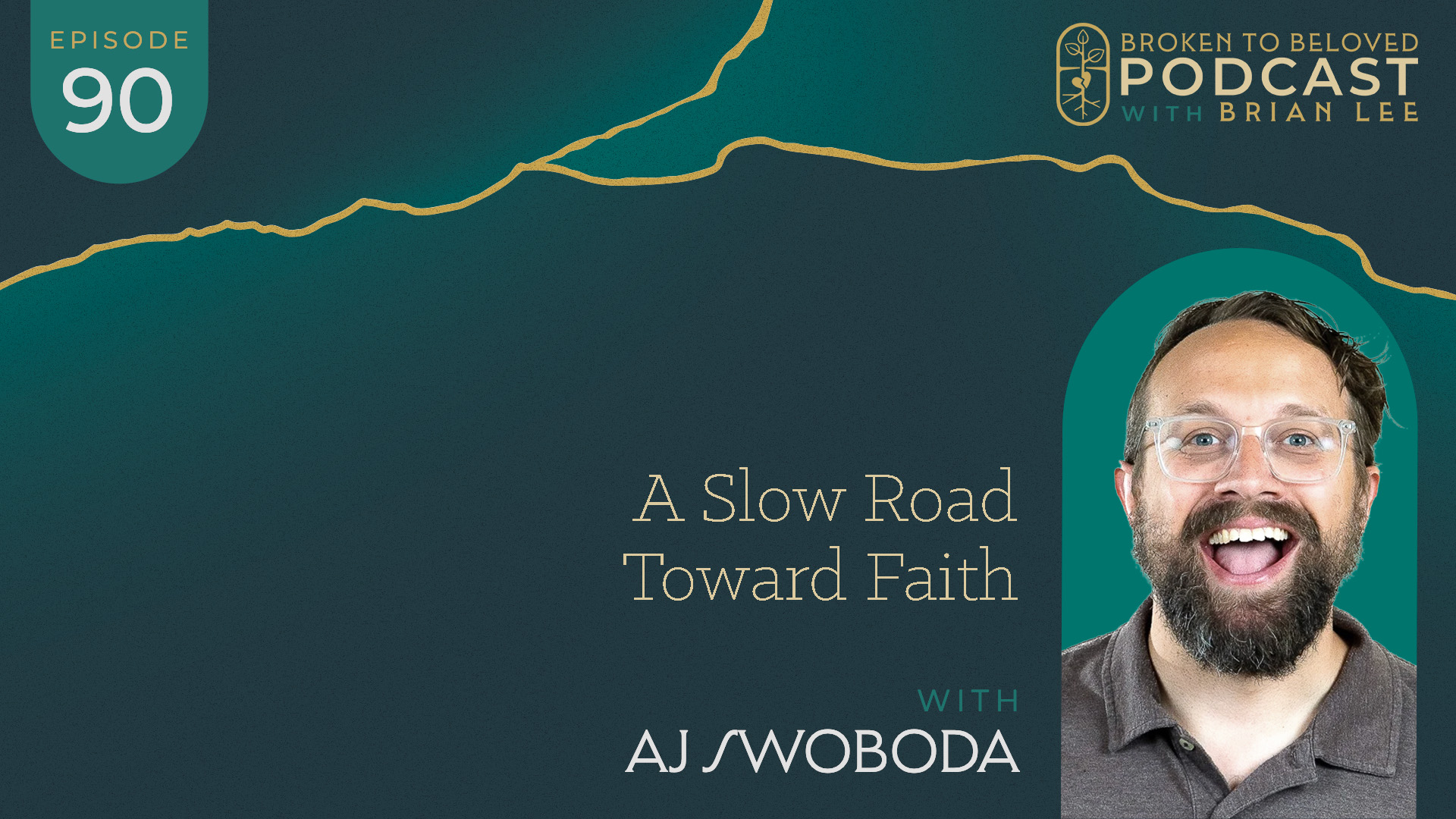
After spiritual abuse, how do you separate the voice of Jesus from the voices that harmed you?
In this conversation with theologian and pastor A.J. Swoboda, we explore why slowing down — not speeding up — is the key to rebuilding a durable, honest faith after spiritual harm.
How do you trust truth again when it's been weaponized against you? This conversation explores how we can learn to trust truth again when it's been weaponized.
There can be ways to hold strong beliefs without becoming harmful, to understand that belief is not certainty, and that genuine theological knowledge should produce humility, not arrogance.
You'll learn:
- Why treating faith like a commodity does long-term damage
- How truth is often used as a power play in religious communities
- How to hold beliefs with humility rather than certainty
- Why fundamentalism is a mindset that can exist anywhere on the political or theological spectrum
- How lament is a legitimate and important part of the faith journey
Guest Spotlight ✨
Rev. Dr. A. J. Swoboda (Ph.D., Birmingham) is the lead pastor of Faith Center in Eugene, Oregon and is the associate professor of Bible and Theology at Bushnell University. He is the lead mentor of the Doctor of Ministry program in Christian Formation and Soul Care at Friends University. He is the author of many books, including The Gift of Thorns (Zondervan), After Doubt (Brazos), and the award-winning Subversive Sabbath (Brazos). He hosts the “Slow Theology” podcast (w/ Dr. Nijay Gupta) and writes the widely read “Low-Level Theologian” Substack. A.J. lives and works on an urban farm with his wife and son in Eugene, Oregon.
Links & Resources 🔗
Substack | Website | Instagram
- Slow Theology Podcast
- Slow Theology by AJ Swoboda & Nijay Gupta | Amazon | Bookshop
- After Doubt by AJ Swoboda | Amazon | Bookshop
- Good Soil by Jeff Chu | Amazon | Bookshop
- The Understory by Lore Wilbert | Amazon | Bookshop
- The Critical Journey by Janet Hagbert and Robert Guelich | Amazon | Bookshop
Don’t Miss the Next Episode!
Sign up for our Podcast Newsletter and subscribe on your favorite podcast app below and never miss out on these conversations with old and new friends. Is there a guest you’d like to hear from? Let us know!
Apple Podcasts | Spotify | Amazon Music | YouTube
Spread the Word. Leave a Rating and Review. It would mean the world if you would leave us a rating and review on Apple or on Spotify or share with your friends.
Broken to Beloved is a 501(c)3 nonprofit that works to provide practical resources for recovery from and safeguarding against spiritual abuse. Our programs like this podcast are made possible in part by the generous donations of our supporters. Consider joining our community of supporters with a gift of $25 today.
As an Amazon and Bookshop.org affiliate, I may make a small commission at no extra cost to you.
Episode Transcript 📄
AJ Swoboda
What would it look like to do the work of reflection in meaningful and slow ways? You got to slow down, do it in community with one another through struggle, and so really the heart, yes, is stop treating your faith like a commodity as you've so wisely called it, and take the slow approach towards the faith in meaningful and slow ways.
Brian Lee
Hey friends, welcome back to the Broken to Beloved Podcast. If you're looking for practical resources for recovery from and safeguarding against spiritual abuse, this is the place for you. I'm your host, Brian Lee. I'm an ordained pastor and spiritual abuse survivor, and I know what it feels like navigating life after spiritual abuse. It's why Broken to Beloved exists.
And we can't do it alone. We need your help. Support our work by becoming a donor to help make our podcast and programs possible. Just head to brokenbeloved.org/support or click the link to donate in the show notes. Just $5 or $10 a month would go a long way to making our work more sustainable.
Today we're talking about a slow approach to re-engaging faith and theology with the Rev. Dr. A.J. Swoboda. A.J. is the lead pastor of Faith Center in Eugene, Oregon, and is the associate professor of Bible and theology at Bushnell University. He's the lead mentor of the Doctor of Ministry program in Christian Formation and Soul Care at Friends University. He's the author of many books, including The Gift of Thorns, After Doubt, and the award-winning Subversive Sabbath. He hosts the Slow Theology podcast with our friend Dr. Nijay Gupta and writes the widely read Low Level Theologian Substack. He lives and works on an urban farm with his wife and son in Eugene, Oregon.
I do want to provide a short disclaimer before we dive in. This conversation will cover lots of topics around deconstruction, theology, and faith. You may not find yourself where AJ is, and that is totally okay. I wanted to offer this conversation as one of the many options and resources in your own journey of faith, including choosing not to pursue any faith right now. There may be some language or discussion topics that feel uncomfortable or perhaps even judgmental or certain. It is not our intent or hope that you feel judged, condemned, or certainly not retraumatized. All that being said, if this doesn't feel helpful to you, by all means, feel the freedom to pause or stop altogether. We value your agency over any prescription. This conversation with AJ is not a prescription of what or how you should do things, and I hope you feel the freedom and agency to choose what to do.
And now here's my conversation with our new friend AJ. AJ, welcome to the podcast.
AJ Swoboda
Brian, it's a gift to be with you now in kind of face-to-face way. We've had a phone call, but it's good to be together in this way too.
Brian Lee
It is. I'm looking forward to talking about the book. I almost said After Doubt, but we're not talking about that one. We're talking about Slow Theology written by you and Nijay, and we're really— I was taken just by the title, I think, when I saw Nijay first post that you guys were working on it. So much of faith has become a commodity, hasn't it, in a consumeristic culture that wants fast answers now. So help us understand why this slow approach and what, you know, what was the impetus for you and Nijay doing this work?
AJ Swoboda
Yeah, yeah. No book is accidentally written. You know, it comes out from, from a, you know, in most cases, any writing comes from a story or a narrative or, or I often tell my students, write out of your anger, something that you're mad about. That's often something that helps you discern what you should. The book Slow Theology is actually a smaller part of the project that both Nijay and I have been into as of the last 6, 5 years, which is that we've hosted a podcast called Slow Theology, which is an overflow of a book I wrote years ago called After Doubt, and the reason we started this project and have continued to do this project is that we have seen, we've had the privilege of sitting— privilege, painful privilege of sitting in the front row of watching people in our circles and then in our world go through a very sped-up deconstruction process. And, I'm not talking the positive deconstruction, I'm talking about deconversion process of individuals who during COVID post-COVID of living your life kind of saturated in these digital spaces, just really kind of shredded their own faith in many respects, and today would say that they no longer identify as Christians.
I think part of what Nijay and I wanted to do was to invite us to slow down and don't make immediate, really immediate, quick theological decisions, but take the time and the journey to become deeply formed in the way of Jesus. That is not something that happens because you read one book, You know, you got to slow down, do it in community with one another through struggle, and so really the heart, yes, is stop treating your faith like a commodity as you've so wisely called it, and take the slow approach towards the faith as you know if we took Eugene Peterson famously quoted Nietzsche and defined formation discipleship as the long obedience in the same direction, If we applied that to theology, what would it look like for us to do theology at a Sabbath pace? What would it look like to do the work of reflection in meaningful and slow ways? That's really what we're trying to do.
There's a lot of books recently about slowing down. You know, my friend John Mark Comer wrote a book called The Ruthless Elimination of Hurry. There have been a number of really great books written. My friend Alan Fadling on hurry and the dangers of hurry. So this is just adding to, you know, what I think is a conversation the church is broadly having. Theology is rarely served by immediacy.
Brian Lee
Yes.
AJ Swoboda
Yeah. So that's— yeah, that's the heart.
Brian Lee
That's great. You open the book right up at the introduction of just saying, belief is not certainty. It is conviction, but humble conviction. And certainty breeds arrogance. But true faith is gentle and humble. And that just right off the bat felt really gracious, helpful, kind. And you go on in the first chapter to open up and just saying that the Bible is a book that deals with great pain and you recognize how it's been wrongly used and manipulated to undertake evils. Talk about Frederick Buechner again and saying that the resounding message of the sacred account is that despite every last pain and setback in the story of creation, The God of the Bible refuses to give up on what he has made. And you say to be a follower of the way of Jesus is to embrace this hope that God will eventually turn all evil and darkness into good and light on the day of his glorious restoration, end quote. And I think there are so many people in our community who want to believe that and understandably have a really hard time. So how would you offer hope to lots of people who may be having a hard time finding or holding on to hope and faith?
AJ Swoboda
Well, I mean, yeah, there's so many different facets to the journey of pain and the journey of suffering as it relates to our discipleship journey. There's so many things we could talk about. One way I like to talk about this is, you know, the Old Testament prophetic literature, the Book of Job, which wrongly Job scholars will very quickly point out Job is not an answer to the problem of pain. It is not an answer to why God allows suffering to happen. There's no answer in the book of Job to these questions. The point of the book of Job is not how God answers suffering. It's that God is present to the sufferer. One of my favorite features of the book of Job is the vocabulary of Job. Job has more— Job has the most extensive Hebrew vocabulary of any book in the Old Testament. You cannot read Job without a lexicon. Every other word is like a word that's never used again in the Old Testament. So, the vocabulary of Job necessitates slowing down. Not only is it written in poetry, which can never be read quickly, it is written with a vocabulary that would blow all of our minds.
Whoever's writing this book is clearly intending to require their listener to slow down. And I think gives a nuanced understanding of suffering. I think one of the lessons of Job is if you're going to talk about suffering, you can't do it with cliché and bumper stickers. You've got to have a really nuanced vocabulary. You don't use overarching statements that cover everybody's experience because that's not— So that's one way to think about it is that that those experiences in our life that have left us deeply wounded— spiritual abuse, trauma, deconstruction, whatever it may be— the worst thing you can do is rush through those experiences. We want to because we want the pain to go away, but the pain is often what makes us. I think another way I'd talk about it is an image that comes out of my own, literally out of my own urban farm that I live on. This little— we've got nearly an acre in the, in the city here in Eugene where we live, and we have 12 chickens and a lot of composting. So composting is a, is a really interesting image because what is compost? When we compost, which always makes the best soil— compost always makes the best soil— compost is basically all the stuff you don't want that's just been sitting in a pile for a long time.
That's all it is. So you take all of these grass clippings and weeds and, you know, dead apples and rotting pears, and you put them in a compost, and you turn them over and over and over again, and before long, you know, a year later, you've got some incredible soil. And I like to describe the God of Scripture as the divine composter. He shows himself time and again to be able to take that which is evil and turn it into good. He takes the pain of our life, the suffering, the trauma, and he has a way of turning it over and over and over again in such a way that he can eventually grow some really beautiful things out of it. But we have to give it time. Compost can never happen overnight. You've got to let it sit for a long period of time before it becomes what you want it to be. So don't rush through it. Job would say, you know, don't put a timestamp on when this journey is going to end. Let the Lord be the divine composter who does the deep work in our hearts and minds in those seasons of difficulty.
Brian Lee
Yeah, thank you. Compost is one of my favorite analogies, metaphors, and I'm constantly pointing people towards Good Soil by Jeff Chu and The Understory by Lore Wilbert.
AJ Swoboda
Oh, Lore is phenomenal.
Brian Lee
Yeah, they're just both just so good, and I love that idea that it looks like death and decay, but something beautiful is happening and new life is available because you just let it sit there.
AJ Swoboda
Yeah, that's beautiful. Yeah.
Brian Lee
And I love that idea around poetry. I think it's like way later in the book, but you quote Eugene Peterson about how poetry just can't be hurried or rushed and how it actually requires us to slow down.
AJ Swoboda
Yeah, which I hate. I, I, I, I don't, I, I don't like— I— it's ironic that I say that because I hate poetry, and I actually find the, the poetic literature of scripture to be the hardest stuff for me to read. Largely due to the fact that I really want to be efficient with my time and get through the morning daily office readings, and I don't want to have to slow down. I don't enjoy things that force the Sabbath pace of life. I don't like it. I say all this stuff and I hate it. I mean, I love the Bible obviously, but I hate slowing down with every part of me. Yeah
Brian Lee
Yeah, let's talk about deconstruction since you mentioned it. And so many in our community are either in that process, entering, in the middle, maybe coming out of. You and Nijay offer this look at deconstruction that I haven't heard anywhere before. And I loved it. The idea that like chemo, which is developed from this toxic mustard gas. That whole passage was just really eye-opening for me. And the idea that it deconstruction can be like good poison. That you get the dosage right, that deconstruction in the proper dose can save your faith, but the wrong dose can be fatal. Tell us more about that.
AJ Swoboda
Well, Nijay, part of me wishes Nijay was on this call, 'cause that's—
Brian Lee
Same.
AJ Swoboda
I mean, yeah, I mean, but the image is one that's very personal to him. His daughter as a child nearly died nearly succumbed to the cancer that she had. And this image for him is one that's very, very personal. But, you know, when you think of chemotherapy, it is essentially— and I've had a number of friends who've gone through it— you're basically killing— you're getting as close to dying as possible. I mean, it's— it is this, this balance of poisoning yourself or somebody that is dearly loved. And bringing them to the brink of death so that they can survive. Having walked, Brian, with countless individuals through the deconstruction journey, you know, one of my— this one story comes to mind of a young woman who sat in my office during office hours years ago, and she had been raised in a quote-unquote Christian community, depending on how elastic you're willing to be with the word Christian, but she was raised in an environment that taught her that if a man ever lusted after her or stumbled because of her, it was her fault. She bore the responsibility of men's hearts, and she, you know, this basically as a child had taught her that everybody else's struggle was hers.
She had to bear that on her, and she's sitting in my office, Brian, basically that this ungodly form of modesty culture that she was raised in basically had led her to the brink of saying, "I just can't be a Christian anymore," and so what she needed in that moment was the last thing that she needed was somebody who tried to give her, you know, the right theology of modesty or whatnot. I could have done that, but what she needed was she needed somebody to sit in the office with her and just get so mad about the baloney that she had been given. And I sat, I just felt like she needed it. I started using very choice language to say how absolutely horrible that is and evil and wrong and what that did to that girl's little heart. And she needed to just for a season of her time, she needed to shred that system she was given and on the— not to shred it for the sake of being done with Jesus, but to shred the lies so that she could love Jesus. Yeah. And, you know, in the course of time, she was able to go through that journey and come out the other side with the faith of a Jesus who is more clearly seen in the New Testament than in her bad theology.
So in a way, I mean, that was a chemo experience, a spiritual chemotherapy. She, she had to endure shredding some of her false theology in order to rise, arrive at an authentic faith. And if you think for one second that's an easy thing to do, her parents thought that she was losing her faith. Oh, sure.
Brian Lee
Yeah.
AJ Swoboda
Everybody kind of looked at her like, what's— when in reality, this girl just needed to process the anger of what she's going through. The girl loves Jesus more now than she ever has before. But she needed to go, you know, through the chemo experience to get there. So I think what's dangerous— and I more and more I talk about deconstruction, I've been doing it for like 10 years now, but the more I do, I also think it's very important to recognize that not everybody needs chemotherapy.
Brian Lee
Yeah.
AJ Swoboda
Meaning forcing people to go through the deconstruction journey as though that's the only authentic way to faith is like saying everybody needs chemotherapy.
Brian Lee
Right.
AJ Swoboda
So we do a huge disservice to people who don't need to go through the deconstruction journey and force them into it. Sometimes people don't need to. So don't, don't expect everybody to need to be where you are at. Maybe.
Brian Lee
Right, right. And that can be the fatal dose, right?
AJ Swoboda
Yeah, right. Yeah. You give chemo to a healthy person, it could just kill them immediately if it's not done under the supervised care of a trained professional. You know, you could do tremendous damage to somebody. Yeah. So chemo can save a life, it can kill you.
Brian Lee
Yeah, absolutely. Well, I'm gonna reference Lore again. She pointed me towards The Critical Journey, which has been super helpful. I know how helpful and instrumental it's been in her journey, I guess we can say. But that whole idea, like you're saying with this young lady who just needed someone to witness and share her rage at what she had experienced and been taught and all of these things that took her so far off track from what grace includes in her life. And it's such an important part. I think it's in stage 4 of that journey inward. And when we hit that wall and do that deconstruction process, that for people who are in stages 2 and 3 who are just still under discipleship or serving, that they can't understand that taking a step back is actually moving forward. And it looks like losing faith or losing all of these things or moving backwards or whatever it is. I also think of Erin Moon wrote her book, I've Got Questions, and she writes about the idea of a controlled burn.
AJ Swoboda
Burn.
Brian Lee
And then yes, we can come out of these horrible experiences and have the urge and talk about wanting to burn it all down. And I think kind of similar to chemo, it's like there's also a dose and a way that you do a controlled burn that actually saves more and encourages growth rather than just being a destructive thing.
AJ Swoboda
Yes, very well stated. That's a cool image, controlled burn. I hadn't thought about it that way. That's a great way to think about that. Underlying all of this, Brian, is the perennial problem that nobody has a shared definition of what deconstruction is, because in some sectors of the church there's no shared Google Doc on this. And so in some circles, deconstruction is assumed to be deconversion.
Brian Lee
It gets conflated a lot.
AJ Swoboda
Yeah, and that's so wildly unhelpful, just as it's unhelpful to call Thomas Doubting Thomas. When we call him Doubting Thomas, I've done a whole thing on Obviously, you know this. His name is Thomas. He's never called Doubting Thomas. But how quickly in our sermons, preaching, homiletic stuff, we call him Doubting Thomas. What an indictment on the Western church. And it's an indictment because what we do when we do that is we wed a person's struggle to their identity. So we take the doubt and we make it their identity. And the minute you do that, then you are essentially telling somebody You are bound to do this because it's a part of your identity.
So what do we do in our communities with people that ask questions and are wrestling with things as we assume, well, that's just who they are, failing to capture the heart that this is a named human being that is walking through a real journey and a real story. Don't wed them to their struggle. This is not who they are. Deconstruction can be very catastrophic. And very life-giving, depending on what is being deconstructed. The Bible has a word for deconstructing lies. It's called repentance. So it depends on what you're deconstructing, not if you do it, but what you're deconstructing.
Brian Lee
Right. That's a really powerful idea, uh, wedding our struggles to our identity. I mean, that's what I did for years. It's just like my identity was broken because that was my struggle. So I was just broken Brian, kind of like doubting Thomas. You know, in addressing these lies, you write Orny J. writes, quote, "What matters most is not necessarily the speed with which we believe in something. One can err on either side. What is most important is the truthfulness of what one is believing." And it's why taking one's time can be so important. I don't disagree with that. And yet, for people who have had the word truth so weaponized against them, how are we moving forward to know and discern what truth is? And/or choose to trust again in people who claim to know or speak the truth? It gets so tricky for people who like get thrown for a loop.
AJ Swoboda
Yeah, Brian, fabulous. And you have a remarkable gift of asking good questions, and that's not a universal gift, I can assure you, friend. Well, two immediate things come to mind. One is the New Testament gives us a very odd epistemology. Epistemology is, you know, how one comes to believe or the nature of belief, the nature of knowledge. How does one know? And the quintessential gospel on knowledge, to know, is the Gospel of John. John uses, more than any other gospel, John uses the word faith more than any pistis is kind of a core Johannine theme. So John's epistemology is wrapped around faith. Well, you ask yourself the question, like, faith in what? And, you know, most— in most systems of knowledge, truth is— in most systems of knowledge, I'm actually going to agree with Foucault and Derrida here, if I'm allowed to. In most systems of truth, and knowledge, truth is a power play. So when somebody says, do you believe in the truth? What they're saying is, do you agree with me? Yeah, because if you agree with me, then I get the power.
Brian Lee
Yep.
AJ Swoboda
It's a rare moment to have a conservative Christian theologian agree with Foucault and Derrida, but they were absolutely right. And in the sense that human beings in their fallen state will bend truth as a power play. Completely agree. And I think Jesus agrees with me. I think Jesus agrees that humans have the capacity to do this. And I think we see this in the confrontation that Jesus has with the religious leaders of his time who were making truth claims and were basically articulating a vision of God that was subservient to what they wanted. What's really interesting about the Gospels is how Jesus never quotes the rabbis, never once. He never quotes the rabbis. He only quotes himself. Now, that's quite the gutsy move to never, you know, his footnotes were very odd. Had you read his footnotes, he would be like, as I said, in, you know, because he's self-referential. Jesus is referring to himself because Jesus was truth. And in John's Gospel, we are told Jesus makes the most important epistemological truth claim Christians could ever hear. I am the way, I am the truth, and I am the life. In almost every system, we are taught that truth is a set of propositions or beliefs.
But for the kingdom of God, truth is a person. It is Jesus Christ himself. So in a world, I find that to be exceptionally liberating and life-giving in a world where truth is weaponized. Yeah, because when you have been taught truth is what my denomination thinks. Truth is my interpretation of Scripture. Truth is what I say. In a world that weaponizes truth for power plays, Jesus comes along and says, I'm the way, the truth, and life, and you're not. So every single truth claim now gets to be read through Jesus. Jesus is truth himself. You want to know what truth is? You've got to go to Jesus. So what that means is that confronts all of us, because all of us misuse truth for our own purposes. All of us do. Dallas Willard, in one of his less read articles, says that in a world where our desires are constantly being aroused by everything, right, we're constantly having our desires aroused, our desire eventually begins to die. And what we chase then are things that wake up our desire again. And he calls us— he has a word that he uses for the Western world.
He calls us a Viagra society. We are a society that's constantly trying to find arousal all over again. And I'm in the process of writing an academic article on Willard's theology of desire. In the end, Willard believed most truth claims that people make are really just their desires projected on theology.
Brian Lee
Wow.
AJ Swoboda
Is that we use theology as a way to fulfill our own desires. And I think Willard is absolutely right.
Brian Lee
I think that's spot on.
AJ Swoboda
So what's the other side to this? I think the other side to this is that at no time in history has it been more important for Christians to root their brains, hearts, minds into the Gospels—Matthew, Mark, Luke, and John—than now. Because if Jesus is truth, then everything depends on what Jesus says and who he is, and nothing could be more important. I got hammered by somebody who was mad that I have not been talking enough about political issues from the stage, and I said, I said, "I don't think you understand how prophetic and subversive I'm being." And they said, "Well, what are you doing?" And I said, "Well, I'm getting up in the mornings and reading the Gospel of Matthew, 'cause that's the most prophetic thing a person can do right now, is to actually root ourselves in what Jesus says." And I think my point is, I don't think there's anything more transformative than a people whose minds and hearts are in the words of Jesus, who is himself the word. Truth. So that would be my response.
Brian Lee
Yeah, thank you, and I can appreciate because I think there are plenty of people out there, especially people who have just been— not just, but you know, attending churches, been part of churches whether it's their whole life or not. It's easy to make this excuse of, oh well, I'm not a theologian, or but I haven't studied this or that, and I love that you address that and you just say everyone is a theologian because everyone thinks something about God. And that the goal is not, is never merely, quote, theological knowledge. The goal of theology is always an encounter with the living God. And you talk about that about pointing back towards God, who himself is the truth. And so if we are all functioning theologians in a way, you also share this great old tweet from Heather Thompson Day, right, about this student whose entire academic career changes, quote, because she had a bed. Starts out with this, I think, 1.2 GPA and graduates with honors just because she had a bed. And making the point that without rest, we tend to do the work of thinking about God by rushing and through frenzied minds and cutting corners and all of this stuff.
I'm thinking about how our executive functioning goes offline when we're in survival mode during and after abuse and trauma. And if you don't feel qualified to answer this, that's totally fine, and I get it. But for those who are carrying spiritual trauma and and feeling that frenzied mind or anxious mind with good reason, and yet still want to find a way to hold onto that faith. Do you have suggestions for how they can do that slowing down to find a bed to rest in? 'Cause you also write quite a bit about Sabbath and rest and that slow pace. Where do we start when it just feels like our mind is going 100 miles an hour?
AJ Swoboda
Well, first, anxiety, let me talk about that for a second. I have had, we've all had areas in our theology that we've needed to, make corrections because we've realized that what we think is garbage. One of those areas for me is my theology of anxiety. I think had you asked me 10 years ago, I would have said theology is a theological crisis, that if you have anxiety, there's a problem with your theology. And I've come to absolutely disagree with myself on that. You know, I want to be a non-anxious presence, but the truth is our Savior Jesus at the Garden of Gethsemane experiences a level of anxiety that is unexperiencable by human beings. He sweats blood. The anxiety is as deep as possible. You know, I think Jesus was a non-anxious presence some of the time, but not in the Garden of Gethsemane. He was a very anxious presence in the Garden of Gethsemane, experiencing the worst of the worst of the worst. I think what's important is to stop shaming ourselves for anxiety. So be Be kind to yourself. And are there forms of anxiety that are sin? Sure, yeah, of course there are.
But to say all of it is, is not accurate. So be slow to be mean to yourself, because when you experience trauma, Jesus had a nervous system too. And Jesus, I can guarantee you, had stories in his life that triggered him. When he walked into different rooms or he experienced, he was a full human being. Jesus had a nervous system. So to think that, you know, you're supposed to be better than Jesus is the ultimate heresy. You're not better than Jesus. So take a deep breath. Okay, secondly, in the book we talk about, there's a psychological concept called cognitive load carryover. The idea of cognitive load carryover is that if you're driving down the road, let's imagine that you're driving down major highway thoroughfare and you're going 70 miles an hour and all of a sudden you're late to a meeting and you come up to a traffic jam and you're late to a prayer meeting. You're going to a prayer meeting at church and you know, and you're like, oh my gosh, I'm late now. I'm behind all these cars that are slow. There's a car wreck, traffic jam. What happens to your blood pressure?
Well, your nervous system kicks into gear and you are, You know, you're dysregulated, you're feeling all the feels, sweating, you're getting frustrated, maybe cussing under your breath because you're going to the prayer meeting and you finally get to the prayer meeting 45 minutes late. You're sweating, frustrated, mad, you're apologizing to people as you come in. Well, it turns out this is, you know, everybody's gonna be like, well, of course that happens, but there's a word for it, cognitive load carryover. It turns out you cannot separate different areas of your life from each other. So what ends up happening is anxiety and rushing in one area will immediately translate into anxiety and rushing into another area. So that means you are bringing in that rush hour spirit to the permitting. Okay. So you're taking it. It's almost like the speed at which you live in one space is the yeast that goes through all the dough and eventually it's affecting every other area. You can't separate it out and be like, okay, I'm going to be super regulated in one area and super dysregulated in another area. So that principle, though, also goes the other direction, that when you begin to live into peace and a slowed-down spirituality and patience in one area, it can also bleed into the other areas.
So it can go both ways. You can— the anxiety can go from one to the other, and peace and a regulated heart rate and all this stuff can go from one to the other. So here's what— here's how I would suggest for the person that you're describing, how do they begin? Begin by practicing what the medieval church fathers called stasio. S-T-A-T-I-O. And the idea is for the medieval, many of the desert mothers and fathers and many of the medieval church fathers, what they would do is they would plan in an hour between their meetings or their prayer gatherings or whatnot. They would plan in a 10 or 5 minute break between their engagements, just these little tiny breaks. Basically what this is, is it's taking the idea of the Sabbath and applying it on a minute-by-minute level. So for every 1 hour between stuff, take 5 minutes to stop and breathe. I don't believe this is going to fix everything, Brian, but I think that in a small way, those little stasio moments of just pausing between things and saying, thank you, God, for the last hour, I acknowledge you, I'm present to you, I'm here with you, I'm trusting not in my own ways, but I'm leaning God, in my understanding of you, I'm leaning on you right now.
That little pause, um, I think plays a prophetic role in bearing peace into the next thing. It is like a theological cognitive load carryover. Your little tiny moment-to-moment Sabbath bleeds into the next thing, and before long you come home and you're not coming in hot, you're coming in because all day long you've had little mini sabbaticals throughout the day. I think that's a, that's a, it's a really great practice in between stuff. Take 5 minutes, schedule 5 minutes to pause and be present to God.
Brian Lee
Yeah, and it's just a moment to, to regulate that nervous system. That's right. That's right. Yeah. Uh, you and Nijay write that, quote, one of the greatest signs that we have wrongly done the work of theology is if our knowledge of God makes us more full of ourselves rather than more humble before God. And there's so much I'm learning and doing work around this idea that whether you are conservative, moderate, progressive, liberal, wherever you find yourself moving or fixed along that spectrum, that we can carry fundamental views and postures with us that smack of that idea of being right and holding the truth, like you said earlier, and learning how important that posture of humility is to avoid that fundamentalist 'Cause we've heard of plenty of progressive or liberal fundamentalists who leave and swing to this progressive conservatism and the other way around, vice versa, because they took the fundamentalist ideas with them where I used to believe this, but now this thing happened to me, so I'm swinging all the way over here, but now all of this is right and you have to agree with me over here, and if not, then you are whatever word you want to use.
And I think it's that certainty and sureness that gets us in trouble. And you talk about this idea that the people, the very people who claim to know the most about God, the theologians, are the ones who killed God. And so it's important for us to have this wrestling with tension, right? And I think you say it's often not the problems that are the problems, but our discomfort with the tension. And I love the analogy that you guys used of a guitar. I don't know if that was you or Nijay, Can you tell us more about that?
AJ Swoboda
Well, first, yeah, if your theology is leading towards arrogance, then your theology needs to be reconsidered. Not that the theology is wrong. Here's what's ironic is very often those that embrace Orthodox Christianity, it is not the theology that's wrong. It's that that knowledge of the truth has now sort of created a mindset that I'm in the inner club, and I've made it because I've known the truth. It's kind of a form of Gnosticism more than anything, like this sort of esoteric, I've got the truth, so therefore that makes me special. And what we end up doing is completely forgetting that all revelation in and of itself is a gift from God. There's never— I like to say God never butt dials. There's never been a moment where God has accidentally communicated something to somebody. So if you know the mystery of the Trinity, if you know the mystery of the Atonement, if you know the mystery of the Incarnation, that is a sacred gift from God. That he didn't have to give you. Karl Barth's entire theology of revelation to me is the one part of his theology that really is— he had some weird stuff, but one of the things I love about Barth was that all theology is a gift from God, and you can't get it without God's willingness to share it with you.
So I think if you've truly experienced theological knowledge that's a gift from God, it always humbles you and does what happens to Isaiah when he walks into the temple. The first words out of his mouth in his vision, and he says literally, he says in Hebrew, he says, 'Oi vey,' 'Woe is me,' you know, 'Who am I? I'm a man of unclean lips. I don't deserve to be in this space.' So fundamentalism is a mindset. It is fundamentalism. You can be a fundamentalist progressive, You can be a fundamentalist conservative. You can be a fundamentalist libertarian, for heaven's sake. You can be a fundamentalist whatever. Everything can be fundamentalist. And the spirit of fundamentalism is, or the mindset, the righteous mind as Jonathan Haidt calls it, is the mind that says, because I have some knowledge, I am the righteous one. I'm the enlightened one. I'm the in one. And if our knowledge of the truth of orthodoxy and good, truthful, biblical theology leads to that, then we've missed the train somewhere. We've got to go back. Good theology should always break us. It should always humble us. It should always make us more dependent upon God, more hungry, more hungry for God.
Yeah, I mean, a guitar, and that was an image we take credit for all the good stuff in the books. I actually don't remember whose that was, whether it was mine or Nijay, but a guitar is a series of strings that are all tightened at different levels, some tighter than others, some whatnot. And it's this combination of some things that are held tighter and some things that are held looser that makes for a beautiful sound. And as a Christian, I hold very tightly, Brian, to core Christian doctrines like the Trinity, the Incarnation, Atonement, a biblical theology of human sexuality, the theology of compassion and mercy. I mean, I hold very tightly to many things, but I hold a lot of things super open-handedly, and those things are things that I just don't know, I'm not really convinced of, and I've got to learn to know where to hold tight and where to hold loosely, and that's That's a hard thing for any of us to do, because see, that's the problem. That's what fundamentalism does, is it holds everything tight. So if you're a fundamentalist, people have to agree with you on your nuanced theology of angelology, or you're not in or out, because every little jot and tittle must be agreed upon.
Helmut Thieleke was a German theologian back in the 1960s, who wrote this book on grace, and he says, isn't it ironic that the people who have the highest view of grace for sin— so people who will say through faith in Christ you can be forgiven of murder, of sexual adultery, of, you know, gossip, you can be forgiven— that very often those people that have grace for sin have zero grace for bad theology or theology that disagrees with theirs. Yeah. And he basically says, like, if you really believe, you got to have grace in sin and grace for theology. We make room for the process, the theological journey. None of us have fully arrived. The ironic thing is that we would often forgive murder but not somebody who thinks differently about the return of Jesus. You know, that's it. Um, so yeah, it's ironic you called it.
Brian Lee
You called it. It is ironic. Well, and often these are a lot of the churches where the senior pastor or leader has some kind of horrible convicted failing. Oh, and they're welcome back with open arms and standing ovations because God has grace and mercy for you, which I want grace and mercy for the pastor, but grace and mercy for the rest of us too. Absolutely, absolutely. There's a lot we're not going to have time for, which I want to give an honorable mention to the idea of pain of life making us into an Etch-a-Sketch or a Polaroid. That was super helpful. That was such a good mental picture. I'm going to take credit for that one.
AJ Swoboda
Take credit for that one. That one's mine. And it's an image that I— yeah, so like, we're all going to have, right, stories in our life that shake us up. We're all going to have things where we're like, okay, I wasn't expecting that. That really stinks. That's really painful. So we— and this has always been something I thought about— we are either Etch-A-Sketches or Polaroids. And an Etch-A-Sketch is you shake it and it destroys the picture, right? But a Polaroid, you shake it and the picture becomes clear. And I would hope that for all of us, as we're shaken, we are the Polaroid image. We become more and more clear. So I'm not going to take credit for much, but I get credit for that one. That one's mine, Brian.
Brian Lee
It's all yours. I mean, you guys talk about that, talk about pain, lament about how much theology must be a communal act, but I think the thing I want to close with is John 10:3-5 and how Jesus talks about the sheep listen to and know his voice, and recognizing how so many people have been tricked, deceived, coerced, whatever word we want to use, into hearing the voice of their pastor as an ultimate authority instead of Jesus, and then harmed, abused, manipulated whatever in the process. And so for people who are wanting or looking for Jesus's voice again, but don't know how to differentiate it from the false voices that they've been with for so long, what do we do with that? How do they look for somewhere to trust again, or how to recalibrate their discernment tool or their listener? How do they learn to separate the stranger from the truth.
AJ Swoboda
Yeah. Oh, that's a really great question. Well, there's a line in Romans that I, I, I, I, I think is a great way to end, and that is Paul uses this line, uh, I think it's Romans 2. He says, let God be true and every man a liar. In his— I think his core concept there is he's basically saying like, you can learn from people. It's okay to learn. You should learn from people. It's great. We got to learn from people. But in the end, Jesus is always right. He's the trump card. He's like, there's no ifs, ands, or buts. And I don't want to make it too trite, and I don't want to make it too simplistic, but I really do think there's something to be said about setting aside meaningful and intentional time as much as we can in our life to reading the Gospels. And I already mentioned that, but reading the Gospels all the time. And in all of our daily office, in all of our attempts at reading Scripture, we should always have one chapter of the Gospels that we are meditating on, that we are struggling with, that we are being corrected by.
And just leave that reading remembering that whatever you just read is truer than whatever your pastor preached, and it's true that whatever theology you've ever read, Jesus is always right. Let God be true and every man a liar. Have a healthy skepticism of sinners. Be realistic. If at any point you believe that your leader is always right because you trust them, you are setting yourself up to be deeply wounded. Whoever that leader is, be it a theologian, be be it a therapist. Your therapist is not perfect. Don't treat them as perfect beings. The number of stories that I've walked through of people who've been hurt by the therapist, and they were, you know, taught that therapy is somehow the sanitized space of humanity. There is no human being other save Jesus Christ who can be universally trusted. So have a healthy skepticism. I would call it a faithful skepticism of sinners. Um, and let, let that Christ be true in all things.
Brian Lee
Thank you. Romans 3:4. I found 3:4. Uh, I looked it up just to make sure I knew where I was going to put it. So AJ, thank you so much for this. This has been so helpful. I hope clarifying for a lot of people who are listening who are struggling with, I don't know what to do with my faith anymore because of these things. And I'd love I love the idea that you and Nijay approach it slowly. We want to point people toward your podcast. If people are looking to connect with you and/or Nijay, where can they find you?
AJ Swoboda
Well, both Nijay and I hate the internet, so I don't know. We both have Substacks that we write that are probably where we're most active, and his is called Engaging Scripture. Mine is called The Low Level Theologian. We write a lot there. I think that'd be a great place to start.
Brian Lee
We will send people there. Thank you so much for taking the time for doing this, AJ.
AJ Swoboda
Brian, you're doing great work. Thanks for serving God's people. Thanks.
Brian Lee
If you enjoyed this conversation as much as I did, be sure to follow AJ and say thanks for being on the show. You can find links and all the things in the show notes. Subscribe or follow the show to get new episodes automatically. If you enjoyed this episode, please leave us a rating and review or share with your friends. It really helps us to grow.
And a special thank you to our listeners who make the show possible through their financial support. If you find the show valuable, consider donating today at brokenbeloved.org/support or at the link in the show notes. This episode was hosted and executive produced by me, Brian Lee.
Thanks for taking the time out of your day to listen. I hope it's been helpful. Here's to moving toward healing and wholeness together. I'll see you next time.