088: Carrying the Weight of Hope with Heaviness with Shannan Martin
Mar 24, 2026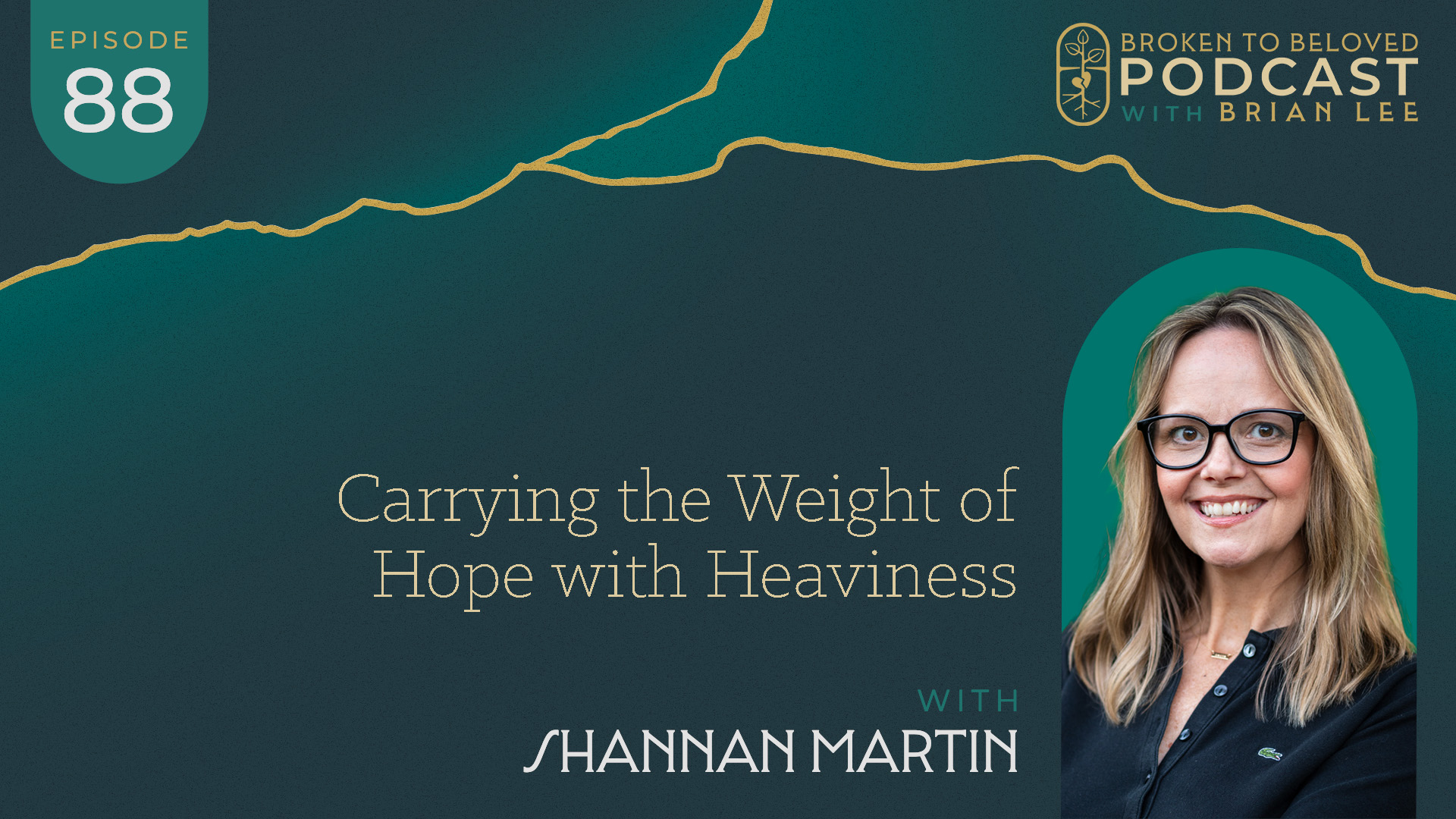
What can we do when the world just feels so heavy?
In this episode, neighbor and author Shannan Martin shares her “counterweights” practice—how we move forward by carrying life’s heaviness with equal measures of rest, joy, and community. Together, we explore how to navigate the burdens we carry and the importance of community, grief, and hope.
Shannan shares why we often can’t set our burdens down (and how privilege shapes who can), how grief is a counterweight to loss, and how naming both our weights and counterweights becomes a path to healing. From jailhouse church to backyard gardens, she shows how neighbors, embodied practices, and hope as a renewable resource keep us upright in a complicated and lopsided world.
You’ll hear:
- How grief functions as a healing counterweight to loss
- Simple counterweights that aren’t just self care or spiritual bypassing
- How being a neighbor can help and serve the vulnerable in your community
- Why curiosity over certainty can be a counterweight in a changing faith—and how to rebuild belonging
Guest Spotlight ✨
Shannan Martin is the bestselling author of several books, including Start with Hello, The Ministry of Ordinary Places, and the popular Substack The Soup. Shannan is a wannabe gardener, a news geek, a fighter for justice, and a thrift store stalker. She and her family live as grateful neighbors in Goshen, Indiana, where Shannan is on staff at the local community kitchen.
Links & Resources 🔗
Website | Instagram | Substack
Similar Episodes You Might Like
-
Episode 2: Embracing Death and the Hope of Wholeness with Lore Wilbert
- Episode 47: Reframing the Meaning of “Good Soil” with Jeff Chu
Don’t Miss the Next Episode!
Sign up for our Podcast Newsletter and subscribe on your favorite podcast app below and never miss out on these conversations with old and new friends. Is there a guest you’d like to hear from? Let us know!
Apple Podcasts | Spotify | Amazon Music | YouTube
Spread the Word. Leave a Rating and Review. It would mean the world if you would leave us a rating and review on Apple or on Spotify or share with your friends.
Broken to Beloved is a 501(c)3 nonprofit that works to provide practical resources for recovery from and safeguarding against spiritual abuse. Our programs like this podcast are made possible in part by the generous donations of our supporters. Consider joining our community of supporters with a gift of $25 today.
As an Amazon and Bookshop.org affiliate, I may make a small commission at no extra cost to you.
Episode Transcript 📄
Shannan Martin
We can try our best to detour around pain, you know, to keep it as far away from us as possible. I think the only way through is through, to feel what we feel, to allow ourselves to grieve. I write in the book that grief is the counterweight to loss. And again, that, that's an idea that you— we don't think of grief as a counterweight, as something that helps. But ultimately, grief for me, as I have allowed myself to grieve some of the pain and some of the harm from the church situation or any number of things. That's how I begin to heal.
Brian Lee
Hey friends, welcome back to the Broken to Beloved podcast. If you're looking for practical resources for recovery from and safeguarding against spiritual abuse, then this is the place for you. I'm your host, Brian Lee. I'm an ordained pastor and spiritual abuse survivor, and I know what it feels like navigating life after spiritual abuse. It's why Broken to Beloved exists.
And we can't do it alone. We need your help. Support our work by becoming a donor to help make our podcast and programs possible. Just head to brokenbeloved.org/support or click the link to donate in the show notes. Just $5 or $10 a month would go a long way to making our work more sustainable.
Today we're talking about counterweights with Shannan Martin. Shannan is the bestselling author of several books, including Start with Hello, The Ministry of Ordinary Places, and the popular Substack, The Soup. Shannan is a wannabe gardener, a news geek, a fighter for justice, and a thrift store stalker. She and her family live as grateful neighbors in Goshen, Indiana, where Shannan is on staff at the local community kitchen.
I can't wait to share this conversation with you. And so here it is with our friend Shannan.
Shannan, welcome to the podcast.
Shannan Martin
It's very good to be here. Thanks for having me, Brian.
Brian Lee
Yeah, it's so good to talk to you again. Congratulations on the release of your latest book.
Shannan Martin
Thank you. I know. Here we are. Yeah.
Brian Lee
How are you feeling?
Shannan Martin
I'm feeling energized and hopeful. There's, you know, I'm in the phase right now where there's, there's a lot to be done, a lot of little details to attend to. So I'm grateful for anyone that's helping me do that. But yeah, it's, it's at the part of the journey where You know, everything still feels kind of possible, and you just hope that the book finds the people who need it the most.
Brian Lee
Which I think in this day and age is just about everybody.
Shannan Martin
Yeah, I kind of, I kind of agree with you. I really do.
Brian Lee
I very much agree with me. So, um, it's such a timely book, and I know that books take a long time to write, and you've been talking and writing about Counterweights for a long time.
Shannan Martin
Yeah.
Brian Lee
But I— the release is just being timed correctly. So I'm really excited to talk about it with you. The idea, obviously, I mean, it's right there in the title. You've been talking about it, this idea of weights and counterweights. And I love that you start us out just talking about this idea of carrying two full buckets.
Shannan Martin
Yeah.
Brian Lee
Right. That you kind of compare Rilke with your dad. I love the quote, "We must learn to carry the cosmos." And sometimes it feels that way, that the weight of the universe is on our shoulders as individuals, as a community, as neighbors. And you also say, quote, "From where I sit, balance is a fool's errand. There's too much to pretend everything— there's too much everything to pretend a sustained state of perfect equilibrium is possible. What would balance even look like?" And so I think that's the question when we, when we think about two buckets, what do we do when those two buckets are just get too heavy?
Shannan Martin
Right. I mean, that's, that's the question. Yeah, it's, it's really meaningful to open the book with this juxtaposition between Rilke, this, this poet that many of us have learned a lot from and continue to learn from, and my dad, Dwight Garber. You know, he's a— he's my whole life, he's been a blue-collar laborer. He built, you know, he's built homes and bridges and different things over my lifetime. My parents are very practical Midwestern people. Very unfussy. My dad is not— has probably never read Rilke and might not have heard of Rilke. And yet they give us this, this really rich and almost visual metaphor for what does it look like to carry everything that life gives us? You know, Rilke talks about the beauty and the terror. That's what life is sort of made of. And my dad, just to give a little bit of context to this metaphor that carries us through the book, When I was young, he would talk to my siblings and myself about this idea of if you're carrying something really heavy in one hand, the best way to do that is to carry something equally heavy in the other hand.
And it sounds counterintuitive. It sounds like doubling up on the weight would be a terrible idea. But I saw from a young age that, that there was a lot of wisdom in that idea that when we carry two heavy things, you know, one in each hand, it keeps us at center. It keeps us upright so that we, we can move forward rather than kind of dragging or lurching to one side.
And so if we think of our lives as sort of a scale, you know, picture a scale in your mind. And on one side, we have these really heavy things that we didn't ask for, and we have very little control over them. And we, we don't really necessarily want them. And yet here they are. This is part of life. We have this other side of the scale that we do have a little bit of say over. And we can choose, you know, what do we want to load onto that other side of the scale so that we are carrying two buckets that are heavy with weighty things. Some of them we might think of as negative or bad, but on the other hand, we have these really beautiful, delightful, joyful, sustaining, joyous things that, that can't perfectly balance or counteract the heavy things that we're asked to carry, but that can help us move forward.
I think that's the, that's the goal. That's the human project is to understand we are asked to carry a lot in our lives and our job is to figure out how to do that.
Brian Lee
i love that you related to cooking, which I love doing. I love that you related to David Chang and his quote, just like, true balance is not an average. It's two forces in equal nature. Right? So you take bland rice and really spicy chili oil, and you put them together and bang, you get something fantastic. And so it's not necessarily balance that we're looking for, but like that equal measure that you're talking about. When it does just get to be too much, how do you stop to take rest or a break or put the weights down for a minute? What do you do?
Shannan Martin
I am a believer that we typically cannot put the weights down. You know, the things that weigh me down are often things that I cannot choose to set them down even if I wanted to. That is when— whenever I get to feeling like things are too much, and it's often lately, if I'm being honest, and it's in different ways, you know, the heaviness comes at me in different, in different ways. I look for my counterweights. I just, I look for those things that can lift me a little further off the ground, those things that can offset the heaviness just a little bit, because we, we can't put it down, but we can choose to pick things up that help alleviate some of that, that heaviness. So, you know, you mentioned a moment ago, Brian, like, how do you rest? I mean, rest is a counterweight, and rest is going to look different to us at different times. I mean, for me, I'm trying really hard. I'm failing as of right now, But I'm really trying to be an adult about bedtime and, and go to bed. I am a night owl by nature, and I'm also not sleeping great at night.
You know, I'm waking up earlier, and so I'm just incrementally— I'm getting less and less sleep, and that's not great for me. It's not great for anybody. And so I'm trying to prioritize sleep as a counterweight, understanding that this is one of the things in my life that I do have some control over, and you know, what would it look like for me to prioritize that a little bit, to understand that I need to care for myself, that I'm the only one that can sleep for me. Nobody else can do that for me. And so sometimes it's physical sleep. Sometimes it's saying, you know, blocking social media from my phone. I have one of those brick devices.
Brian Lee
Yeah.
Shannan Martin
So bricking my phone. And so again, we can't put down the bad news, but we can put some boundaries around it at times. I'm a big believer in staying engaged and staying aware of the heavy things that are happening around us. I think that's really important right now, but we can only take so much before we need to take a step back, sit down for a little bit, and focus on, on things that remind us of all there is to love about our lives. Because And probably, although things feel kind of terrible in a lot of ways, I still really love my life. You know, I think most of us do. We, we want to hold on to it. And that can feel kind of confusing to feel like, you know, this is really hard and there's a lot going wrong and I still really love it here. And I think, again, that that takes us back to this is what it looks like to be a whole person in a complicated world.
Brian Lee
Yeah, I really appreciate that answer, Shannan, thank you. And I appreciate that you use the word offset because in my brain, like I'm such a black and white, right and wrong thinker. It's easy to imagine weights and counterweights as supposed to be like canceling each other out, which is not the truth. Because like you're saying, it's, it's double the weight, but the counterweights help to keep us moving forward without lurching to one side or the other.
Shannan Martin
That's right. That's it.
Brian Lee
And one of the best lessons I learned from you in the last, I think it was 2 years ago or 3 years ago now, is how something that might seem really complicated for one person is really very simple for someone else. Especially when it's something that affects your everyday or when it may literally feel like a matter of life and death. So the idea that you said, well, I don't really believe I can put my weights down, because as soon as you said that, the word that came to mind is privilege.
Shannan Martin
Yeah.
Brian Lee
The people who can put those weights down have an immense amount of privilege to not have to carry that weight with them all the time, because so many people do and they don't have that option. So I love that. It's such a helpful answer to just think of it as an offset, not necessarily a canceling, not necessarily a balancing, but something that will help you to keep moving forward without just being pulled to one side.
Shannan Martin
Yeah, you know, and some of our weights are— and I wrote through various weights that I was experiencing over a period of a couple of years, maybe as I was thinking about the book, writing the book. Some of our weights are sort of global. Some of them are national. Some of them are kind of circulating up here in the air and we feel them kind of in different ways all the time. Some of them are medical needs, our bodies. Some of them are relational, you know, divorce, death, you know, all of these things that again, we often just— there's nothing we can do about this, but figure out, this is my life. This is what I am being dealt right now. How do I carry it?
Brian Lee
Yeah. And I love that you say, quote, "This is not a silver lining situation, where pain and injustice are minimized for the sake of flimsy optimism or just playing nice." there are so many people in our community who have experienced spiritual bypassing, minimizing, dismissing, and I love that that's not what you're asking us to do by this.
Shannan Martin
Yeah, yeah. Anyone who's followed my writing for any amount of time knows that I almost, you know, I'm very persistently and consistently reminding us all to turn towards the things that are difficult, to not turn away from them. And you're right, Brian, I mean, there is privilege in being able to, you know, I'm especially thinking of sort of global political things, church-related harm. There are some of us that can choose to just like, I'm just going to pretend like that's not reality. There's, there's real privilege in doing that. And anyone who has been harmed by the church in particular, I know your community really roots into all of that and what that means and how we heal. And, you know, those, those things, which I really appreciate. I'm part of that community. I am, I have been, I have been hurt and harmed by church. It's something I write about in this book. It's a fairly fresh wound for me and my family. And again, you know, it's, it, it can feel like one of those things that just feels, it can be consuming, it can be overwhelming, can be devastating in so many ways.
And yet I think there's, there's always a way through. And the keyword being through, there's typically not— we can try our best to detour around pain, you know, to, to keep it as far away from us as possible. I think the only way through is through, you know, to feel what we feel, to allow ourselves to grieve. I write in the book that grief is the counterweight to loss. And again, that, that's an idea that you, we don't think of grief as a, as a counterweight, as something that helps, but ultimately, and you would know a lot more about this than I would, Brian. So help us out here. But from a layperson's perspective, grief for me, as I have allowed myself to grieve some of the pain and some of the harm from the church situation or any number of things, that's how I begin to heal.
Brian Lee
Yeah. Yeah. I mean, there's so many good— the first thing I think of is J.S. Park, who's so good at just grief. And the idea that you take as long as you need. There's no timeline for when you stop. I mean, some of us just never stop grieving based on the loss that we've experienced. I love the Marvel show WandaVision. Like, people have quoted that so often, like, that grief is— oh gosh, I'm going to butcher it now, of course. What is grief if not love? I can't remember it right now, but it's such a good quote. But I mean, you say it kind of the same way as like, denial was never going to heal me.
Shannan Martin
Yeah.
Brian Lee
Right. When relief was the goal, the facts are paramount. Denial was never going to heal me. And that grief isn't itself the crisis, it's the response to the crisis. And so without feeling the grief, with not allowing ourselves to acknowledge the loss of something that was important to us, how can we, how can we hope to move on? Right?
Shannan Martin
Yeah. And I'm surrounded, you know, I'm from, I'm from a of faith culture in particular that in many, many ways I am grateful for, even as I have sort of shifted and moved outside of some of that. I'm grateful for it. And it surrounded me, especially my more formative years, with some ideas of kind of toxic positivity.
Brian Lee
Yeah.
Shannan Martin
Denial of, you know, I was, I was told throughout life that, you know, the power of life and death is, is in the tongue. And so We just don't say, you know, even if we're sick, we're not going to say we're sick because, you know, on and on and on it goes. For me, that did not work. That did not. Yeah, it didn't, it didn't stick with me. And as I've, I've come more into adulthood, I'm, I'm way into adulthood now. I'm almost 50 years old. And I'm just starting to kind of understand what some of this means. And I just think there's a lot of, I think there's a lot of power good power, positive power in naming, in naming the things that hurt, in naming the things that help us to heal, not in just this, this sort of focus on joy mentality where we pretend that all is right when it is not. I think it's really hard. I'm a very justice-oriented person. I think it's really hard to work towards justice that if you're, if you're not willing or able to name the injustice, You know, so we have to keep naming these things.
What I didn't want to do with the counterweights practice and specifically with this book, I don't want this to be a situation where we are counting our blessings, the end. Rather than just counting our blessings, I want us to be countering our weights and we can't counter what we won't weigh. And so part of this is, is repeatedly, you know, in the book and in the practice that is a part of my life now. Saying out loud the things that hurt, naming them.
Brian Lee
Yeah, I'm learning. Same, almost 50 and learning how important that naming practice is to all of the things. And I love that you identify that grief isn't the weight. Loss is the weight and grief is the counterweight. I think so many of us would consider grief to be the weight.
Shannan Martin
Yeah, I think I would have until—
Brian Lee
Sure, same.
Shannan Martin
Yeah.
Brian Lee
Yeah. I mean, and I love the way that you write it and you already said it, just quote, loss happens without our consent. Grief is the counterweight, and healing means we carry both. And there it is, the two buckets, right? The loss and the grief together.
Shannan Martin
Yeah.
Brian Lee
I had to Google the quote quickly.
Shannan Martin
Oh, good.
Brian Lee
Vision says, what is grief if not love persevering? What a line.
Shannan Martin
That's gorgeous.
Brian Lee
Isn't it though?
Shannan Martin
Yeah.
Brian Lee
And I think there's so much good about that. And there's a section, I think you're writing about your anniversary trip and looking for sea glass. And you say, "I wished I could point her toward the closest bank of waves and whisper one of life's best-kept secrets: hurt people can heal people. Pain is not poison, and imperfection is not a deficiency." End quote. I mean, that took my breath away when I read it, because so often we hear, right, hurt people hurt people.
Shannan Martin
Yeah.
Brian Lee
And it's true.
Shannan Martin
It is.
Brian Lee
And this was the first time I had seen it stated this way. Hurt people can heal people because that's what I believe. It's what we're trying to do. That everyone in this community. Yeah.
Shannan Martin
Yeah.
Brian Lee
Tell us about it.
Shannan Martin
Yeah. So, yes, I believe in that section, I'm writing to my younger self who went into marriage with stars in my eyes, like I was taught to do. And now I'm almost 27 years into marriage. And it's everything I thought it would be and so much more. And we are two imperfect people, still learning the other person and still learning each other, you know, adapting as we both change and grow. And it's much less simple and it's much more complex than I would, you know, people, it's one of those things. It's not that nobody ever told me that marriage would be complicated or complex. I think it's one of those things that until you experience it for yourself, it's just kind of meaningless. Um, and so I'm in the, you know, Corey and I were in the reality of it now. And, and I wanted to honor that. I wanted to write about marriage in a way that felt true and honest and real. And didn't elevate it in unnecessary ways. And, you know, all the things that I have seen done, that quote in particular, hurt people can heal people. I think that's an idea that is rooted into my very heart, in large part because of my husband's work.
He is the chaplain of the county jail and has been for over 12 years now. And we are surrounded, our lives are immersed and enmeshed with people who have been deeply, deeply hurt, almost across the board. In many ways, they have suffered in many ways that I have not suffered, you know, their suffering is different than my suffering. And, and most days, it feels like their suffering is much more severe than my suffering, even though we know suffering is not a contest. It's not, it's not a matter of who's got it worse. But I'm surrounded by people who have survived. They have survived a lot of suffering, and they have helped me heal. They have healed, they have helped their community heal. And so I get to be a participant and a recipient in so many ways to that, to that very fundamental truth. I have borne witness to hurt people offering healing to the world. And I think if we can, if we can begin to see, because I'm like you, Brian, I, for most of my life, have been very black or white, like it's all or it's nothing. If it's hard, it's going to be hard forever.
I mean, these are kind of— those are my wirings. And living in close proximity to people whose lives have a lot of nuance has helped pull me out of some of that. And it's, it's given me a clearer picture of what the kingdom of God can look like, does look like, if we're willing to see it.
Brian Lee
Yeah. There's so much grace in that.
Shannan Martin
Yeah.
Brian Lee
There's so much mercy in that, which you also write about. There's so much of the idea of doing what we can with what we have. You talk about your holy alliances, and when everything is vapor, anything is possible.
Shannan Martin
Yeah.
Brian Lee
I get teary-eyed reading the stories about your friends and neighbors who are incarcerated, but remembering their 10-year-old who is frozen in his memory as a toddler. That line killed me when you wrote that. And it's just like, God, like what— one of the things I've so appreciated about your work is what a fierce neighbor you are to your community. And I mean that in the very literal, your neighborhood, your sidewalks kind of a way. And this online neighborhood that you have cultivated over the years.
Shannan Martin
Yeah, thank you.
Brian Lee
One of the things I admire is you seem to have such a sure and steady finger on the pulse of your very local community, as well as the national and global one. How in the world do you decide or prioritize what gets your attention or care in the moment? How much of it is intentional? How much of it is just part of the way you've just been living?
Shannan Martin
Yeah. I want to, I want to make one quick remark on what you just said about the way that I neighbor in the world. And I just want to give credit where it is due. Anything I know about living as a neighbor, I learned from my neighbors. And that makes me almost want to cry right now. Yeah, it is. It all comes to me secondhand. The ways that I've been loved by people with so much grace and mercy and kindness. That's, that's what made me see what was possible. And that's what made me want to aspire to more. Being loved by people who have very little, in often cases, who, who might look at me as somebody that, you know, maybe they think they wouldn't have anything in common with me. Maybe they would want to put distance between us. And instead, at every turn, they have drawn near to me. And that has shaped my life forever. And so all credit, all credit to my neighbors. Um, to your question now, how do we decide, how do I decide what to give attention to? Boy, I don't feel like I am especially great at sifting through the, the weights.
Um, I can often, especially, you know, I, I write about this and I have for a long time. I used, my husband and I both used to work in politics I care a lot about politics. I believe that everything is— almost everything is political. I see the way politics bears down on my neighbors and my neighborhood and my city. And so, you know, that's— it's something I care about. It's something I'm interested in. It's something I know a little bit about. And just to think of that one realm of life, it's really hard for me to, to discern which thing in that realm gets my attention today? Because it's just constant. It's constant in a way that is consuming and overwhelming, and I have to do my part to try to keep myself remotely healthy. You know, I've just got to keep looking for those counterweights. I think I like the advice that people give to— I'm not really good at this yet, I'd like to work towards it, but I appreciate the advice people give when they say find one or two issues that you really care about and, you know, follow those a little more closely.
I tend to be a little more reactive than that. So I'm just reacting to all different kinds of things throughout the day. Some, some things more than others. What I really hope and the way that I really try to orient my life is that what gets most of my attention is, is the person in front of me, the person that I'm standing face to face with at work, you know, so I mentioned my husband's work. I am a cook at a community kitchen just 1 mile up the road from where I live. I've been on staff there for 7 years now. Um, that's another place where I get to interact with my neighbors and where I get to learn from them and be discipled by them. And so I want, I want the bulk of my attention to go, of course, to my family, you know, my, my circle of friends and acquaintances, my neighbors. But in particular to my neighbors that are, that are most easily and intentionally overlooked. I want that to be where I spend and invest my attention the most.
Brian Lee
I love that. And I would just affirm that what I see from you, which obviously is also curated, but it's, it's, it's a focus on neighbor. Like when you, when you say pick 1 or 2 things to focus on, I think for you, once that number one thing might just be neighbor, the word neighbor. Yeah, because whatever the issue is, it's something that is impacting your neighbor that catches your attention. Like, hold on, how does this affect my neighbor?
Shannan Martin
Yeah, absolutely. You know, I live in a community that is immigrant rich. And so because of that, because of that reality among my community, I'm paying close attention to things that are happening around immigration. And so I think I would encourage all of us that that could be a lens not necessarily the lens or the best lens or whatever, but that can be a lens to, to decide sort of where to put your focus, your attention, your, your efforts. Think about who in your community is the most vulnerable. And that could mean any number of different things. But identify— think of one person in particular. I have a person in mind that I often think of for, you know, if I'm thinking of, of the issue of housing, being unhoused. Food insecurity, addiction and recovery. I mean, I kind of have a person in mind that represents many others, but identify that person and then think a little bit about what would it look like for you to invest time and attention into those issues, those realities that affect that person?
Brian Lee
Yeah. Yeah. And there are so many stories about your neighbors. In this book, and all of your books, and all of your stuff that lives online, I have all of these quotes and ideas around connection and community. And I love that you help us to pay attention to our bodies.
Shannan Martin
Yeah.
Brian Lee
That you say, quote, our human anatomy is our greatest common denominator, a monument to every grave from which we stumbled blinking and breathing. Though our embodied experiences are private, what happens in and through us flows over the world we make together. And then you say we are intertwined, particularly with those whom we'd rather fling from humanity's grand loom. If one of us dulls our capacity to feel, to listen, to taste the truth, the whole tapestry suffers. That is just such a true and beautiful statement.
Shannan Martin
Yeah. And it's real because let's be honest, people are challenging.
Brian Lee
Sure.
Shannan Martin
You know, it's, this isn't, this isn't a rosy enterprise, right? Ask my family how challenging I can be. You know, this is just something that lives within all of us. And I, as a storyteller at heart, I'm only typically going to write the stories that, that have happy endings or show some redemption or, you know, put my neighbors into the absolute best possible light as the wonderful lights that they are in me. And it's not always easy. It's just not. And so. Reminding myself that when one of us is suffering, we are all suffering. I just finished Father Boyle's most recent book, Cherished Belonging.
Brian Lee
Oh yeah.
Shannan Martin
And he talks about the reality that, you know, the people that might be the most challenging to us are often the people who are hurting, often the people who are just in need of healing. And I was really challenged by that, not even in a way that felt overly enthusiastic. Like, I kind of bristled against it because sometimes people can be, you know, people can be difficult to the point of like, yeah, I don't want to give them any excuses, right? If we're just being real people here. And so when our bodies react to something like that, it's good to sit with it and think about why. And, you know, to, to come back to understanding what if we just move through life reminding ourselves all the time that we are all children of God, that if one of us is suffering, we are all suffering. That is a really helpful way for me to stay focused. Yeah. Yeah. And in terms of like being more aware of our body, I wrote about that more in this book because I'm learning it more recently. I've come to this very late in adulthood. And as a person who, you know, I've sat through therapy and been asked the question, where do you feel this in your body?
And I'm, I'm the woman that's like, I don't know. I don't know. I don't feel anything. What are you talking about? Like, I've done some hard work around that and I have miles to go. But learning to be in my body has been a really helpful counterweight. Learning to listen to my body, learning to figure out what is my body needing? What is it asking of me? How can, how can I care for myself? And to take it like one layer weirder, How can I watch myself care for myself? You know, like sometimes we just need to see ourselves caring for ourselves, or at least I do. And so, so that reminder to just, you know, feel our feelings and listen to our bodies. That's something that years ago, I remember saying to my kids when they were young that my kids are— my youngest is 17 now, they're much older. But when they were very young, I remember saying sort of spontaneously, listen to your body. I don't remember what we were talking about. And as soon as I said it, I thought, oh my gosh, is that bad? Is that sinful? You know, I had these ideas around this idea of like our bodies are inherently bad and wrong and trying to lead us astray.
And so healing from, from some of that to be able to, to accept the gift of our bodies being here to kind of help us along in the cause in many ways has been helpful.
Brian Lee
Yeah. Yeah. And I always think of the larger analogy of the body of Christ. I've been searching for the other quote from start with hello, because it's so similar, but it still rings true. When we see ourselves as woven into the same fabric, one enemy is too many.
Shannan Martin
Yeah, those are so hard.
Brian Lee
I have that one saved from you. They are. So it rings true. Like the next time I read it from you, it's like, yes, this is still a common theme. And yes, this is still true. And yes, these are still our neighbors. And yes, our neighbors can be counterweights.
Shannan Martin
Yeah.
Brian Lee
When we choose to look for the beautiful things in them rather than turning them into enemies.
Shannan Martin
Yeah, most often, I mean, most often people are people in community and connection. Those are some of our most reliable counterweights. They can be our weights too.
Brian Lee
Sure.
Shannan Martin
But often they are reliable counterweights. I mean, when I'm, when I'm struggling with, you know, as a person who does work on the internet, that can kind of feel disembodied and, you know, kind of scattered and vague. And if I'm having a hard day with that, just for example, the, the instant counterweight is to spend time with a person, like face-to-face, a physical friend, even an acquaintance, somebody I'm trying to get to know a little bit better. It just brings me back into my body. It brings me back down to where my feet are planted. And, and that keeps me upright.
Brian Lee
Yeah, I could, and we might spend the rest of our time talking about gardening because I'm a sucker for anything having to do with soil and gardening and plants.
Shannan Martin
I love it.
Brian Lee
And I'm recognizing this theme with counterweights of holding on to hope. And I think gardening is so much about hope.
Shannan Martin
Yeah.
Brian Lee
I love that you say, quote, other than a few lackluster years when plunging my hands into soil didn't seem like a viable option, not a spring has passed that I haven't tossed a handful of belief into a patch of dirt and waited to see what would happen. I mean, if that's not sowing and hoping for hope, I don't know what is.
Shannan Martin
Yeah. I think that's why I love gardening. I'm not especially good at it. My dad has become sort of an unofficial master gardener just later in life, and he's, he's so good at it and I'm not. But, but what I know is we can all throw seeds into the ground and try to remember to water them. And usually in spite of our, in spite of our deficiencies, something grows. That is, that is such a metaphor for hope, watching things grow, especially living here in Northern Indiana. The winters are brutal. You know, once things start to come back to life and, and grow, it's such a hopeful time and it's just such a perfect metaphor. And I, I think that's why I've become, you know, uh, uh, I describe myself as a wannabe gardener. I'm not, I don't have a very big garden. Area here in my, my home in the city, but it's enough and it keeps me paying attention and it keeps me, it keeps me hopeful. Just like you said, Brian, that's it. Yeah.
Brian Lee
Yeah. Well, and I love you also write, quote, hope is the thing with chlorophyll that pushes through the soil. And you're writing about your peonies, which I love, and I have peonies. And I think you were the first one who taught me about that 3-year rule. The first year they sleep, then they creep, and then they leap, right? I'm true, almost positive I learned that from you first before I heard it from someone else. And it has become such an excellent metaphor for so many things that even when we plant, it's gonna take a minute. Yeah. But there's such a joy in waiting a full year for that cycle to come around and seeing what happens the next year.
Shannan Martin
Yeah. I have a weird sort of garden adjacent analogy for you. Right now that just— I just thought about this. I don't know if it was last night or this morning. I think it's going to be relatable to a lot of people. Um, and it's also mildly embarrassing. I was thinking about, I mean, I've been in a pretty busy season right now. My husband has a lot going on, our kids, it's just been full. And I had gotten groceries and I bought asparagus and I bought green beans from the grocery store. It's February, you know, we're not growing those things in Indiana in February. And I brought them home and I left for a work trip and I came back and they were disgusting and they had to be thrown away. And I come from like a little bit of food insecurity in my background. And so, and I'm surrounded by people who are food insecure now. And I felt tremendous shame for, you know, here I bought this stuff and I let it go to waste and it's in the trash. And I, why can't I? Be better, you know, in a nutshell, that's how I was feeling.
And in the next breath, well, I think, yeah, we should do our best to not waste food, right? In the next breath, I just had this, this knowing of this is a renewable resource. There will be more asparagus, there will be more green beans. We do not have to shame ourselves or have this scarcity mentality. Around this, this very simple part of life and this, this thing in life that can get away from all of us from time to time. And it brought me peace. And I think it comes back to the idea of the garden being abundant. We're not always going to engage in perfect ways in any area of our life, but the garden is abundant. And the, you know, the hope that we, that we can carry from that is also abundant. And so again, it's a little weird. I'm only bringing it up because I just went through that within the past 12 hours. But, but I'm going to take that with me, you know, that we can, we can walk through life, especially in a time when a lot of things do feel scarce and maybe are scarce. Hope is a renewable resource.
And we learn so much about that from the garden.
Brian Lee
I love that. Have you read Jeff Chu's Good Soil?
Shannan Martin
It's on my table right now, but I have not read it yet. I have it. I bought it.
Brian Lee
Your story reminds me of a scene from his book about processing spoiled food that they would receive truckloads of bagged salad that went bad.
Shannan Martin
Yeah.
Brian Lee
And to tear them all open, handle all the slimy lettuce inside.
Shannan Martin
I do that at work too. Yeah.
Brian Lee
And yeah, I think you just said it like yesterday or today about pulling the lettuce that was bad, right? Yeah. But then you throw it in the compost heap.
Shannan Martin
Yeah.
Brian Lee
And it turns into another kind of renewable resource that new life is going to grow out of.
Shannan Martin
That's right. Yeah, that's perfect.
Brian Lee
And I love that idea. Like, even— yes, there can be shame. It's like, I let this thing go to waste. We wasted our money to buy it and then I let it go bad. And sure, weight. And yet counterweight that. But it's a renewable resource and it's not hard to get it again.
Shannan Martin
Right. I have not ruined my chance of having asparagus for the rest of my life because I threw some way. I don't know, it's— I think often these truths come to us in these very random, ordinary moments of our lives. And if we are paying attention— now, not that everything has to be a metaphor. I am very wired toward metaphor, and to a fault. I know most of us are probably not like that. We don't have to turn everything into poetry, as it were. But I think if we can just get a little better at paying attention to our actual lives, to what is happening around us, to these seemingly insignificant things that are happening to us, I think there's that in and of itself is a counterweight. It's, it's, it's pulling us into the life that we've been given. You referenced our, we do a Sunday morning church-esque gathering. With about 100 of our friends who are incarcerated at work release right here in our neighborhood. And we are called the Holy Alliance. That's the name that we have given ourselves. It's a beautiful, beautiful group of people. And in its earliest days, we were going through Ecclesiastes and this, this word hevel kept coming up through the text.
And so we spent a lot of time talking about what that meant and the Holy Alliance translation of hevel. You know, we talked about, does it mean everything is meaningless or does it mean everything is vapor? We settled on vapor. That's, that felt more true to the character of God. And so how, how Holy Alliance has translated everything is vapor is we only get to do this once. And we do. I mean, it's just, it is so simple and it is so profound for us to really understand this life that we are living that is strapped with weights. That is abundant with counterweights, should we choose to really get serious about paying attention to it and believing that it is all sacred, if we could really remind ourselves that we only get to do this once, it reprioritizes things for us in a way that I believe grounds us and pulls us back to center for the road ahead. So that we can keep moving towards hope, walking towards hope together in community. It's just, it's one of those things that, that phrase, we only get to do this once. I find myself saying it, thinking it so often because some, some days are just really hard.
Some days are crappy. Some days, you know, it's just nothing's going to go right and things are going to feel devastating. And, you know, we know that people around us are suffering even more than we are. All of these things are true. But what if we found a way to love our lives anyway? Understanding that we only get to do it once. To me, that's, that's been really grounding and helpful.
Brian Lee
Yeah, same. And I'll tie that back to the idea of growing things. You know, you talk about the idea that growth is our living testimony. Yeah, that a living faith is a changing faith. And how— I don't want to say sad, but I'm going to— how sad if we spend the remainder of our lives not changing.
Shannan Martin
Yeah.
Brian Lee
And just kind of like calcifying and refusing to change and staying the same. And so when we talk about growth and gardening and soil and coming back year after year to see what happens, tell us about the counterweight of a changing— because there's also loss in that. There's a loss of certainty, there's a loss of community, there's a loss of things that we once held dear. And I know so much has changed for you in the last couple of years. Way of so much has changed for me in the last couple of years. And I think for pretty much everyone who's listening to this, yeah. What is the counterweight of a changing faith?
Shannan Martin
Yeah. You know, all the, you mentioned a lot of the losses and I appreciate that because we're interested in naming them, right? Yeah. As our faith changes, a lot of us lose belonging. And that for me has been devastating. I mean, just on a very personal level. And it also gives me compassion and empathy for the people around me. I love your word calcified, for the people around me who feel kind of calcified in these old ways of belief or thinking. If I can take a step back and think about it in terms of, you know what, I wish certain people would change their minds about certain things. But if and when they do, they will lose their belonging. They will lose their place of belonging for a time. I mean, I think these things can be rebuilt and, you know, replaced. And, and I've seen that in my own personal life, but I think that's just a reality that it's, we do well to remind ourselves of that when we get kind of frustrated that, that others around us are not changing. I am, I can fall into the path of, or the, the trap of believing nobody changes their mind.
And then I remember, oh wait, I did. About a lot of things, you know, I am my best reminder that people do change. Um, but coming from a faith background, like the one I come from, there was a lot of fear instilled in us around changing or changing our minds or being, you know, wishy-washy or not being certain enough. A lot of these things that, that you mentioned. And, and now I just, I believe if we're not changing, we're not growing. Um, somebody somewhere, I don't, this was years and years ago, maybe 10 years ago. I don't know if I heard it or read it. Somebody said, God does not change, so we must. And that has been freeing. That has given me a lot of freedom away from that fear of change and allowed me to see it as liberating, as, as expansive. You know, this idea of stepping into Greg Boyle says, how much greater is the God we have than the God we think we have? I find that really captivating and compelling that as good as I believe God to be, you know, that's one of our foundational tenets at Work Release.
We talk about God is love. What does that mean? You know, what does it mean to look at faith and life through that lens? But to realize like, What if God is even better? Like, what if God is, is greater and even better than anything our limited minds can imagine? I'm taken by that. And that, that allows me to shake off some of the fear around change. And just, you know, thinking of, of you and I connecting, it's like we think of people that we've met. There are so many of us online and through books and social media and in our communities and connections that I've made with other people who are on the path and understanding that maybe certainty is not the goal here, that maybe some curiosity and some mystery and even the willingness to say, you know, I don't know, or I'm not sure, that it's just when I hear any of those things from people, there's a kinship there and a sense of belonging there. Like, okay, we don't have— we're not pretending here. We're not pretending to have all the answers. We value nuance and asking questions and, and kind of figuring things out as we go, or accepting that we're never going to figure some of this out.
Brian Lee
Yeah, I love that. Curiosity over Certainty is one of our stated values for our organization. And so we're always pursuing that. I have so many questions that we won't get to talk about, and that's okay. You've been sharing a weekly newsletter with your community for for some time now. Uh, you write over on Substack at The Soup, you have your Counterweights Weekly.
Shannan Martin
Yeah.
Brian Lee
What are you learning, or what are you finding out in response to what you're sharing or what people are sharing with you, as we kind of wrap up?
Shannan Martin
Yeah, that's a— that's such a great question. I think what I hear from people most consistently through those two places that I do write weekly is that people are finding help and hope through this practice of counterweights. And I think most of us are already doing this to some extent in our actual lives. I don't think for any— for, for a moment that I invented this idea, this, this concept, but I do think I helped us name it. And sometimes just the things that we're already doing, you know, we're all trying to survive, right? We're trying to find ways to experience joy and beauty and delight and all of these things that kind of lift us up. But as soon as we're able to give it a name, what are my counterweights? I mean, that was part of the reason I wrote this book was because I've been accidentally using this word that became a framework for a really long time. And people over the past year started walking up to me, people I didn't know that well in my city, in my community, would walk up to me and reference Yeah, such and such, this was a counterweight for me this week.
I think there's real power. There's real power in naming our weights, naming our counterweights, but also in naming just this practice of considering it all, figuring out how do we carry the cosmos? How do we do it together? I think that's what I'm learning is that there are a whole bunch of us who are willing to do that work and who are receptive to the, to the belief that doing that work together is gonna bring us some wholeness and some health. And I, I find that extremely hopeful.
Brian Lee
Yeah. Well, thank you for giving us the language to put a name to it. Yeah.
Shannan Martin
I'm, I'm glad it's, I'm glad it's helping all of us, myself included.
Brian Lee
Same. What is the best place people can find or connect with you?
Shannan Martin
You can find me on Instagram and Threads, @shannanwrites is my handle. I'm in those places most days. More importantly, the book is out everywhere, and you can find that wherever you get your books. Find me on my website, connect with my Substack, my Counterweights Weekly through my website shannanmartin.com. And yeah, grab your copy of Counterweights. It's got a big peony on the cover, I'll say that since we talked about peonies.
Brian Lee
Absolutely, and I loved it as soon as I saw it. Um, we'll have all the links for everyone in the show notes. Shannan, thank you so much for being with us today.
Shannan Martin
It's, it's my honor. Thank you, Brian.
Brian Lee
If you enjoyed this conversation as much as I did, be sure to follow Shannan and say thanks for being on the show. You can find links and all the things in the show notes. Next time, we'll be talking with author Tiffany Yecke Brooks. We hear a lot about deconstruction and not so much about what happens after. Tiffany has a new book coming out that offers so many practical tools for reconstructing construction, and I can't wait to share that conversation with you.
Subscribe or follow the show to get new episodes automatically. If you enjoyed this episode, please leave us a rating and review or share with your friends. It really helps us to grow. And a special thank you to our listeners who make this show possible through their financial support. If you find this show valuable, consider donating today at brokentobeloved.org/support or at the link in the show notes.
This episode was hosted and executive produced by me, Brian Lee. Editing by Heidi Critz. Thanks for taking the time out of your day to listen. I hope it's been helpful. Here's to moving toward healing and wholeness together. I'll see you next time.